




After taking four weeks of testimony, including joint hearings with the Government Operations Committee and the Human Services Committee and a two-hour public hearing in the well of the House, the Judiciary Committee voted out a strike-all version of S.241 on April 8.
The House Judiciary Committee significantly scaled back the scope of S.241. Through hearing from many witnesses, it became clear to the Committee that Vermont is not sufficiently addressing various problems right now that arise from the use of marijuana in the State. Law enforcement witnesses explained that Vermont lacks the infrastructure to appropriately address risks to highway safety from driving under the influence of marijuana, which is particularly dangerous when combined with alcohol consumption. Although the number of crashes involving fatalities or serious bodily injury has gone down, the number where a driver had THC (the psychoactive ingredient in marijuana) in his or her blood has been going up. Law enforcement does not have the tools or resources at present to address this growing problem.
Although youth usage of marijuana has remained steady, the perception that regular use of marijuana causes harm has been declining. The Committee heard from members of the medical and educational communities on the deleterious effects of regular marijuana use on the developing brain and mental performance. It also heard from members of the education community who explained that the State does not currently devote the appropriate resources to address substance abuse, be it from tobacco, alcohol, or marijuana.
Dr. Harry Chen, the Commissioner of the Vermont Department of Health, reviewed the Department’s Health Impact Assessment related to marijuana. The report explains the many negative health effects from regular marijuana usage, including increases in psychosis, decreased psychosocial functioning, motor vehicle accidents, development of use dependence, and decreased academic performance.
Witnesses from Colorado and Washington shared their experiences and offered advice. The bottom line, however, is that it is too early to tell what the long-term impacts of marijuana legalization will be in those states. Increased usage in Vermont and the increase in negative impacts to highway safety are concerns if Vermont is the only New England state to legalize marijuana given that Vermont is within a day’s drive of some 40 million people.
Judiciary also heard from many proponents of legalization. They explained that marijuana is already widely used by Vermonters. These users should not have to confront the dangers associated with the black market, including product that includes pesticides or other additives and exposure to dealers selling other, more harmful drugs. Individuals should have the same right to moderate use of marijuana as they do to consume alcohol without being subject to criminal penalties so long as they are not causing others harm.
Taking heed of the testimony, on Wednesday the Committee Chair proposed a strike-all amendment to S.241. The bill retained certain provisions of the Senate bill, including sections establishing an education and prevention program, creating a crime for certain dangerous chemical extraction processes (such as was uncovered recently in Winooski), prohibiting the consumption or possession of marijuana in a motor vehicle, calling for the Vermont Governor’s Highway Safety Program to expand its public education and prevention campaign to include drugged driving, requiring additional training for law enforcement, and establishing a workforce study committee. The bill also retained a modified provision establishing a marijuana advisory committee.
The proposal also established a new impaired driving violation to account for the heightened traffic safety risk from polysubstance use – the combined consumption of both alcohol and marijuana. The strike-all amendment would prohibit individuals from operating or attempting to operate a vehicle with an alcohol concentration of .05 or more and any detectable amount of delta-9 THC in the person’s blood.
Acknowledging testimony from numerous witnesses that individuals who use small amounts of marijuana or grow a limited number of plants should not be treated as criminals, the proposal also extended the decriminalization efforts of the last legislature. It provided that possession of up to 2 ounces of marijuana would be treated as a civil violation, as opposed to the current one-ounce limit. It also decriminalized the cultivation of up to two marijuana plants, recognizing that decriminalizing possession of a small amount of marijuana is inconsistent with requiring users to engage in criminal conduct to obtain that marijuana. In addition, the proposal decreased the penalties for other marijuana offenses, changing certain offenses to misdemeanors and reducing maximum jail times and fines.
This proposed strike-all was voted down on a 6 to 5 vote. An amendment to the bill was proposed that took out the provisions related to decriminalization. This strike-all amendment passed on a 6 to 5 vote.
With the strike-all amendment, the Judiciary Committee recognizes that Vermont seeks to address public health and safety issues that currently confront the state from marijuana use. It also recognizes that legalization of marijuana is likely going to occur more broadly in the region. It allows the state to prepare for that eventuality while also addressing current concerns.
In anticipation of our internal deadline for moving bills between the House and Senate, the House passed a number of bills last week that have gone to the Senate for its consideration. Three of these bills improve our criminal justice system by decreasing incarceration, reducing the collateral consequences of a criminal record, and clarifying policing practices. Four other bills that the Judiciary Committee considered before they were passed by the House are discussed below.
H.261, the “ban the box” bill, would prohibit employers from asking on an initial job application whether an applicant has a criminal record. There would be an exception for circumstances where certain criminal infractions relate to the job (for example, childcare providers could ask about criminal records related to child abuse). By prohibiting such a question on an initial application, the bill would give an individual with a criminal record a better chance at not being screened out from an employment opportunity at the initial stage of the application process. At a subsequent interview, the employer may ask about an individual’s criminal record, but also must give the applicant the chance to explain. The law would moderate the collateral consequence of a criminal record by giving individuals a chance in the job market, easing their reintegration into society.
H.623, a bill on parole eligibility, provides that older inmates who have not yet served their minimum sentence but present a low risk to the public are eligible for parole. It applies to inmates aged 55-64 who have served ten years, and inmates 65 and older who have served five years. In addition, an inmate with a serious medical condition that makes the inmate unlikely to be physically capable of presenting a danger to society may be released on medical parole. I was pleased to see this “compassionate parole” bill make it out of the House, as I had cosponsored it with two other legislators.
H.743 extends the legislature’s efforts in implementing fair and impartial policing practices. The bill requires the Criminal Justice Training Council to develop a model policy in fair and impartial policing and law enforcement agencies to train their officers on the policies. In addition, the bill modifies existing mandates related to collecting traffic stop data. Current law requires law enforcement officers to collect roadside stop data such as the age, gender, and race of the driver and the reason for the stop. H.743 requires this data to be provided to the Criminal Justice Training Council and the Human Rights Commission, and that it be posted electronically in a way that is accessible to the public. Law enforcement officials were fully in support of this bill and the improved transparency it provides to Vermont’s policing practices.
The House also passed out two bills related to traffic safety that I have discussed in previous posts. H.571 addresses driver’s license suspensions, which I reviewed in prior posts on March 2nd, February 6th, January 23rd, and January 15th. The bill would fix the broken system in Vermont that relies too much on suspending driving privileges as a means of modifying behavior, particularly as it is misused as a consequence for nonpayment of fines for infractions unrelated to the safety of our roads. It would shift the focus to the points system. Motorists who violate laws that relate to highway safety, such as speeding prohibitions, receive points for such infractions. When they receive 10 points, their driving privileges are suspended because by then it has become clear that they are a danger on the roads. The bill goes beyond the license suspension issue and recognizes that distracted driving reduces highway safety; thus, it provides that an individual violating the handheld ban will receive 2 points for a second or subsequent offense. In addition, it increases the number of points that individuals receive if they violate the handheld or texting bans in a work or school zone. I have previously written about my efforts to address the issue of distracted driving in posts on December 11th and January 30th.
The House also passed H.560, which will add incentives and mandates for individuals to install an ignition interlock device after they have been caught driving under the influence. With such a system, the individual can continue to drive, sober, rather than serving a period of license suspension. Because individuals found to have driven under the influence serving a suspension often drive anyway and sometimes drive drunk, incentivizing first time offenders and mandating subsequent offenders to use an interlock device should lead to safer roads. For further information on the issue, you can view previous posts from March 2nd, February 24th, February 12th, January 23rd.
The House passed out two other bills that the Judiciary Committee had considered. H.818 updates the State’s stalking laws, which I explained in a previous post on February 24th. In addition, H.869 streamlines certain procedures in the courts and adds a new Special Master position to the courts. H.869 is appropriately named the “lighten the load” bill. Finding efficiencies in the courts is necessary because of the alarming increase in CHINS cases (CHINS stands for Child in Need of Care or Supervision) and TPR cases (termination of parental rights) in our court system. These neglect and abuse cases are due to the opiate epidemic in our state and add a substantial strain to the court system, stretching its resources because these cases are complicated, lengthy, and time-consuming. H.869 is a result of many months of collaborative work by stakeholders in the judiciary system and this bill takes steps in finding ways to more effectively and efficiently utilize the resources of the courts. The bill creates a pilot of a new position called a Judicial Master, who will facilitate the implementation of proven treatment court concepts. The Judicial Master will coordinate early intervention and judicial monitoring in cases where substance abuse or mental health issues bring an individual into the judicial system. The bill also streamlines certain appeals of civil violations (primarily traffic tickets) and appeals from the Licensing Board and the Transportation Board.
The next step for these bills is the Senate, where I hope they will receive the attention they deserve and ultimately pass into law.
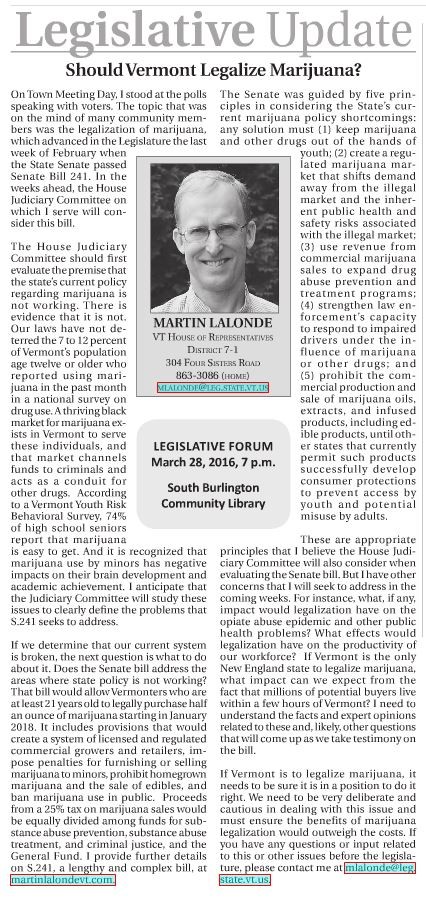
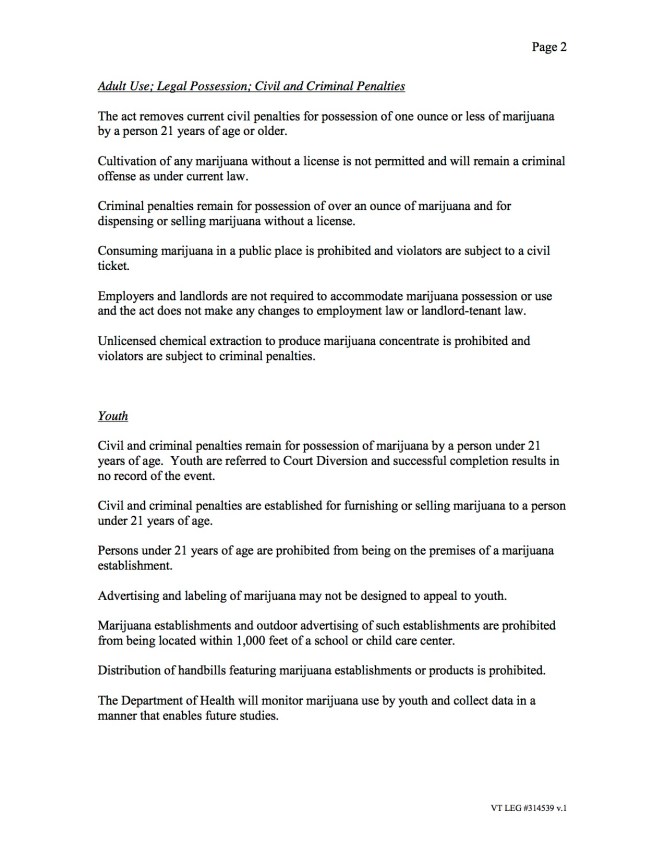
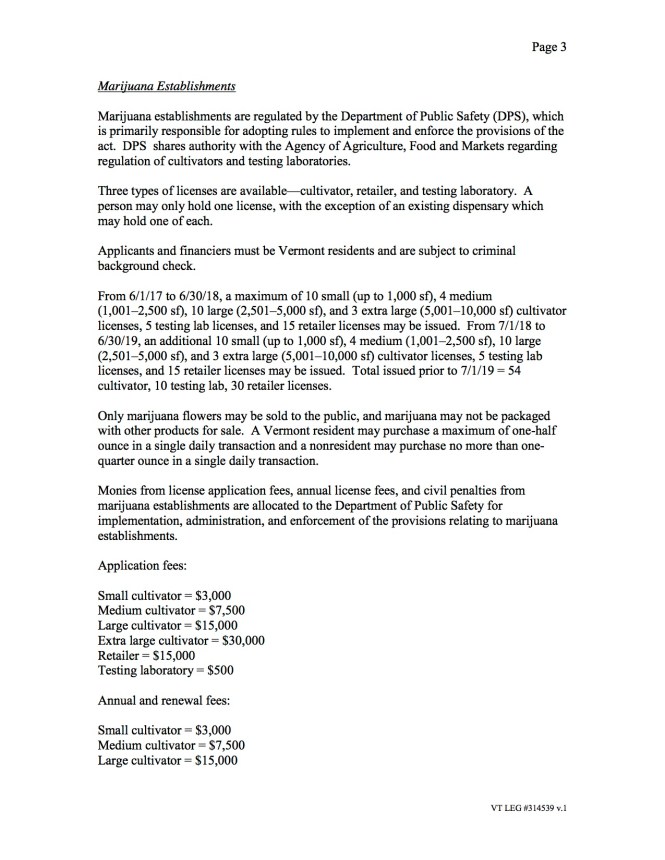
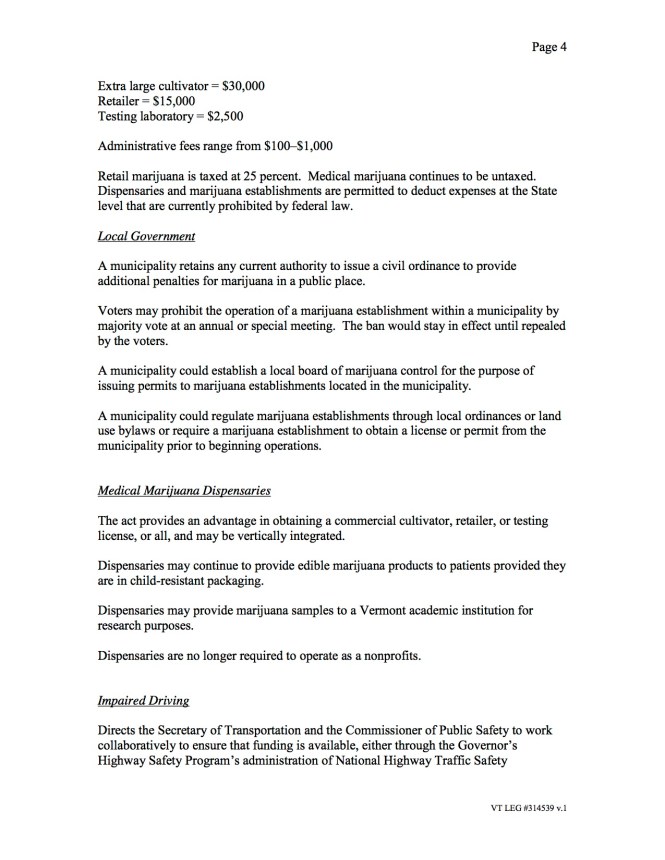
The following is a memo provided by the Legislative Council that explains S.241, the Senate bill that would legalize marijuana. You can see the bill itself here. The House Judiciary Committee will be considering this bill starting later this month.

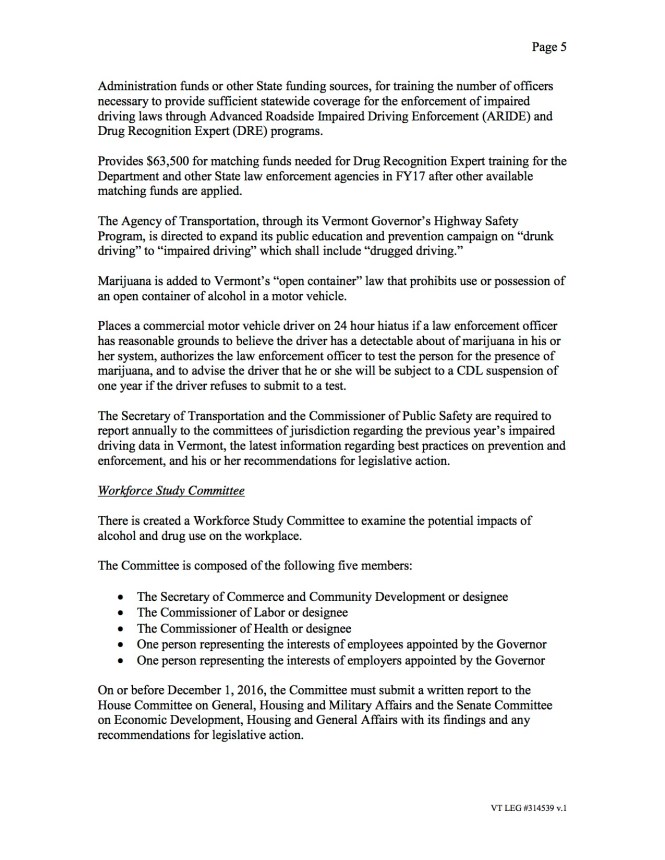
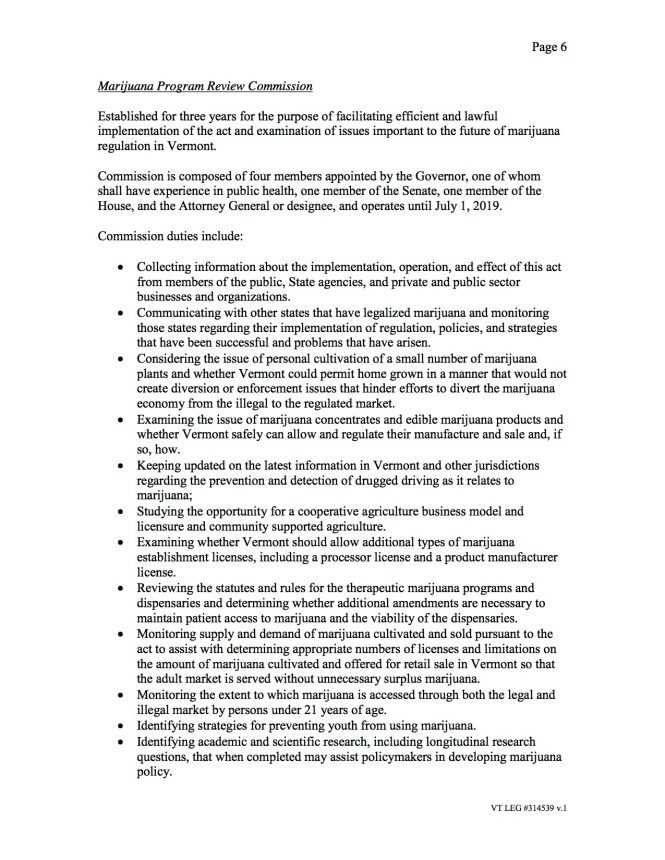


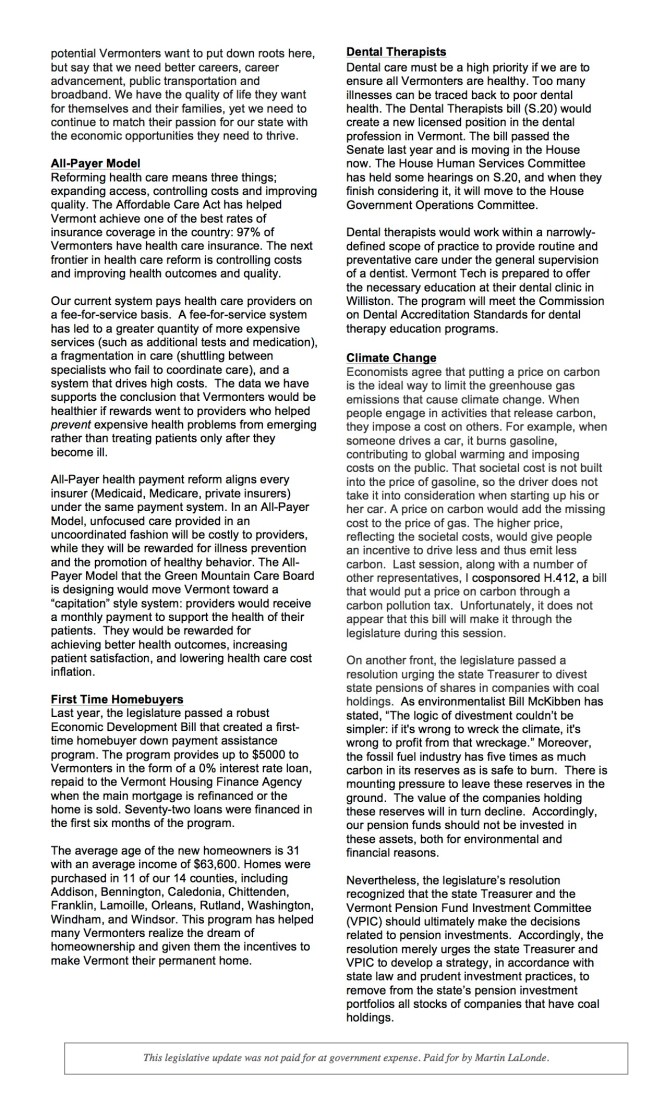
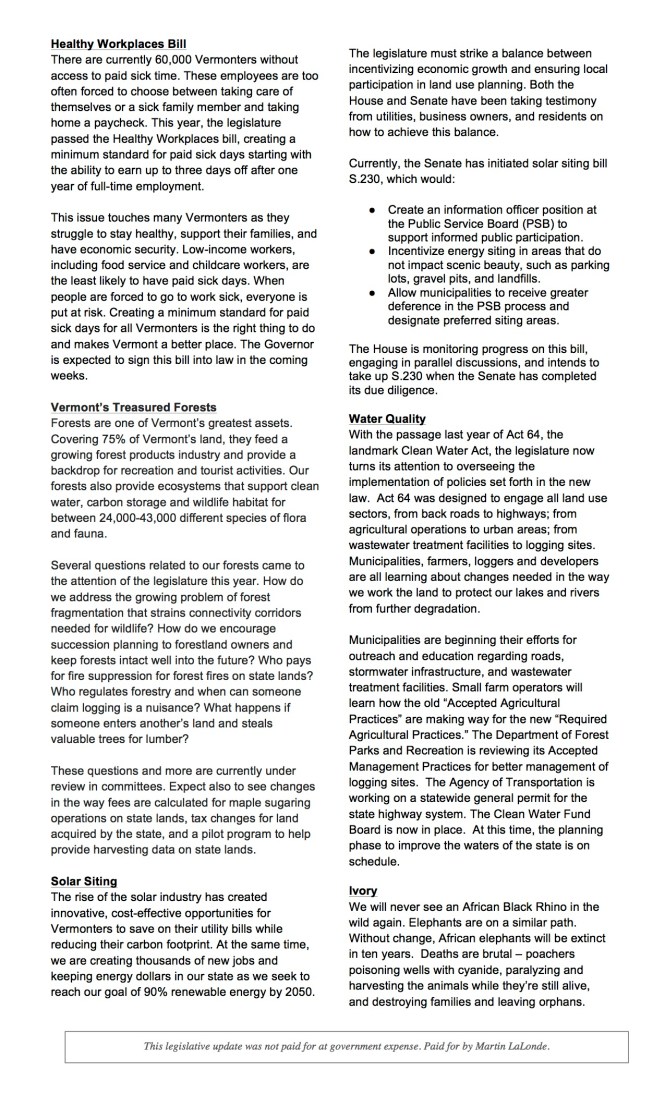
Yesterday I stood outside the polling station at the Orchard School handing out this report, which summarizes some of the issues the legislature has been addressing this year.

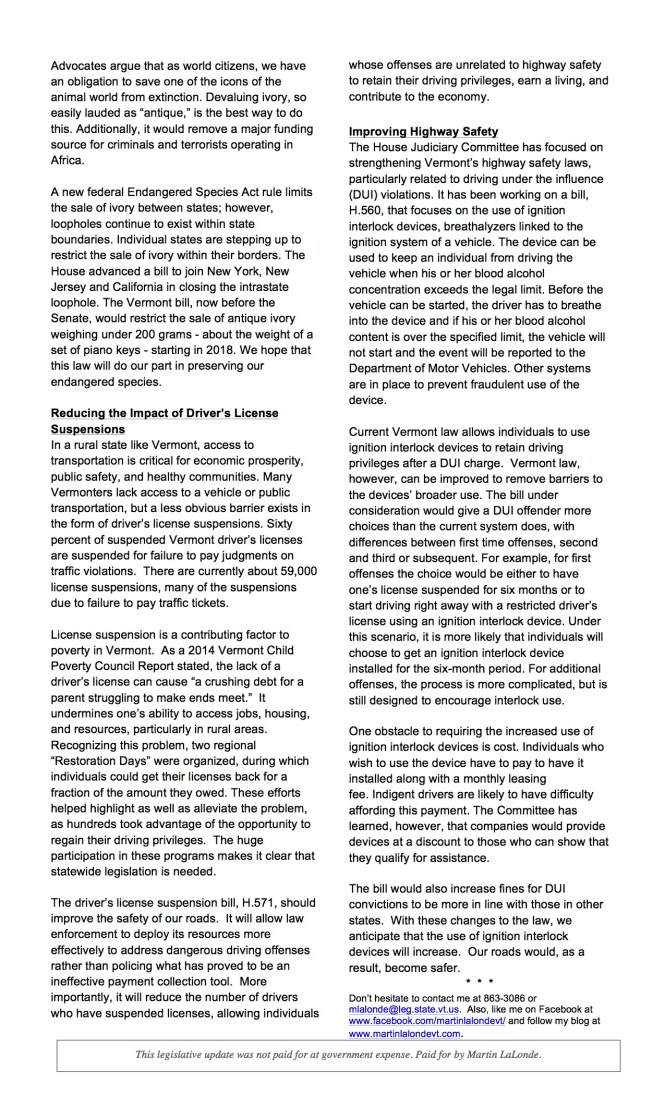
I have found that my service on the South Burlington School Board has helped me understand how the legislature’s decisions related to education affect our community’s schools. Similarly, my work in the legislature makes me a better-informed school board member. I will be running uncontested this coming March 1st for my third term on the Board. I look forward to another three years of working to maintain and improve upon the excellent public education we offer in South Burlington.
Last week, I appeared in a forum on Channel 17 for the two candidates running for the Board. To understand some of my views regarding the issues we face and why I am running again for the Board, click here.
The Judiciary Committee continues to pave the way for improved highway safety. As to H.571, related to driver’s license suspensions, the committee is nearing consensus on how to address the backlog of tens of thousands of suspended licenses. We are also closing in on deciding how to avoid the future accumulation of licenses that are suspended based on failure to pay or other violations unrelated to traffic safety.
The Committee continues to work on a bill (H.560) related to driving under the influence, seeking how best to bring swift and sure consequences to those who drive impaired. Concurrently, the Committee is formulating solutions to ensure that more drivers who have been charged with DUIs use an ignition interlock device in order to reduce the number of impaired drivers on our roads. H.560 also contains a provision that increases the penalty for negligent operation of a vehicle if that operation results in a fatality or serious bodily injury. Currently, there is no additional penalty when negligent operation has such results.
When the Committee has managed to exit from our state highways, we have addressed other concerns. First, H.749, which should soon be out of committee, would allow individuals who are 16 years old or older to seek a relief from abuse order on his or her own behalf (currently one must be 18 years old or older to seek such relief).
H.818 would update Vermont’s stalking laws. In Vermont, 3 out of every 4 stalking civil protective order requests are denied, most likely due to the inflexibility of and confusion surrounding the definition of stalking. That ossified definition is from a different era. The modern stalker is usually not “lying in wait.” Rather, he (or she) is using different technologies to monitor, observe, and threaten victims. H.818 would modernize what it means to stalk.
The bill changes other elements of the crime of stalking. It relieves prosecutors of having to prove a negative, namely that there was no legitimate purpose for the alleged stalking behavior. It prohibits conduct that causes a reasonable person to fear for the safety of another such as a child, not just fear for his or her own safety. It does not require an offender to make an overt threat; he or she need only act in a manner that would cause a reasonable person to feel threatened. It clarifies that the stalker need not have had the intent to cause the victim’s fear, but that a reasonable person in the victim’s circumstance would have felt that fear.
The Committee intends to work through certain concerns raised by court representatives related to this bill in order to update the State’s stalking law.
After a bill is introduced, it is assigned to a committee of jurisdiction. The committee considers the bill and may or may not pass the bill out of committee. If the bill does pass, it will either proceed to another committee for consideration or will go to the House Floor for a Second Reading. (The First Reading occurs at the time the bill is introduced.) The bill is noticed on the House Calendar and the next day a committee member explains the bill to the House, known as reporting out the bill. This past Thursday, I reported out H.533 related to the rights of victims of crimes. The following is the report I provided.
Our criminal justice system provides a number of rights to victims of crimes. Victims have the right to receive certain notifications about the status of the offender, the right to participate in certain proceedings, the right to confer with a prosecutor, and the right to be heard at sentencing.
This bill addresses certain of these rights.
First, it clarifies a victim’s right to be notified. Notification of an offender’s release from custody, confinement, or supervision is essential to the security of a victim. Notifications allow victims to plan for their safety and that of their families and to mentally prepare for seeing the offender in the community. In domestic violence cases in particular, safety planning after arrest and throughout prosecution is vital because of the heightened risk of re-offense during that time.
H.533 will close gaps in the existing Crime Victim Rights statute (Title 13, Chapter 165). It clarifies the victim notification requirements at two key phases in the criminal process: 1) when corrections terminates or discharges an offender from probation and 2) when an offender is arrested, cited, and then released back into the community by law enforcement prior to arraignment.
Second, H.533 addresses a gap in the Crime Victim Rights statute related to the opportunity to be heard. Victims currently have the right to be heard at sentencing hearings. The bill would extend that right to be heard to hearings involving a change in plea that also includes a deferred sentence, which I will explain further when I discuss that portion of the bill.
Altogether, this bill ensures that victims receive statutory release notifications and opportunities to be heard in court regardless of how the case moves through the system or is disposed.
Section One
13 V.S.A. § 5305 sets out the information victims are entitled to request from agencies having the custody of a defendant.
Sec. 1 changes the title of the section from Information Concerning Release from Confinement to Information Concerning Release from Custody. This more accurately reflects when victims are entitled to information about an offender’s status.
Typically in our statutes, Confinement refers to what happens when a person has been convicted of a crime and sentenced to a term of confinement (which could include incarceration or home confinement furlough); custody is a broader term referring to the care or control of a person.
In subsection (a) the bill adds “termination or discharge from probation” to the list of events triggering the right of a victim to request notification before the defendant is released.
Section Two
13 V.S.A § 5314 sets out the information law enforcement must provide to victims of all crimes, and additional information that must be given to victims of listed crimes.
Normally, when someone is arrested, the offender is processed and the States Attorney is informed. The State’s Attorney Victims Advocate is then responsible for notifying the victim of the status of the offender.
But in some situations, this procedure cannot be followed. For instance, an arrest can occur on a Friday night and the defendant taken into custody for processing at the station. Rather than lodging the offender until an arraignment, the court may be called to set bail and conditions of release. The Victims Advocate would not know of the release and therefore could not inform the victim. New Section (b)(6) clarifies that where this situation occurs, law enforcement is responsible for notifying the victim because it is the only source of information at this early stage in the case. It is our understanding that this often already happens, but H.533 will codify the practice.
The new section provides that law enforcement shall use reasonable efforts to give the victim of a listed crime “Information concerning any bail or conditions of release imposed on the defendant by a judicial officer prior to arraignment or an initial court appearance.”
Section Three:
This section was formerly in H.675. Because that bill also involves victim’s rights, the section was incorporated into H.533.
13 V.S.A. § 5321 sets forth the rights of the victim to be notified and to appear and be heard at a sentencing proceeding involving the defendant.
But a court may make some decisions about deferred sentencing outside of sentencing hearings.
If the prosecution and defendant agree, a court may enter a deferred sentence at a change of plea hearing, instead of during a sentencing hearing. If the defendant successfully serves a period of probation, the deferred sentence is dropped. In other words, there would be no sentencing hearing so long as the defendant does not commit additional offenses or violate probation.
It is not clear under current law that a victim can be heard at such a hearing because it is not a “sentencing proceeding.” Some judges routinely allow victims to speak at change of plea hearings in deferred sentence cases. Other judges, however, have adopted a strict reading of 13 V.S.A. § 5321 and do not allow victims to offer their views at the change of plea.
This bill addresses the situation in which the prosecution and defendant have stipulated to the plea and deferred sentence. Under certain conditions, a court may order a deferred sentence where the prosecution and defendant have not agreed to the deferral. In this situation, under existing law (13 V.S.A. § 7041(b)), victims have an opportunity to express their views. This bill extends that opportunity to situations where there is a stipulation between the prosecution and the defendant.
Section 3 adds provisions that require notice and the opportunity to appear and be heard at a change of plea hearing in which the court is considering a deferred sentence. The court shall consider the victim’s views (if offered) in determining whether to defer the sentence.
Subsection (e) adds a provision requiring the prosecutor to instruct victims of listed crimes about the significance of a deferred sentence. This instruction would also include the potential consequences to the defendant of violating any conditions imposed by the court before the change of plea hearing.
Sec. 4. Effective date
Takes effect on July 1, 2016 to allow time for law enforcement to update their practices for providing notification.
We heard from representatives from: The Center for Crime Victims Services, Office of Chief Superior Judge, Public Safety Department, Defender General’s Office, The Department of State’s Attorneys and Sheriffs, Network Against Domestic & Sexual Violence
The Judiciary Committee vote was 11-0.
 Vermont State House Representative Martin LaLonde
You must be logged in to post a comment.