

Author: lalonde
Judiciary Committee Update
I am planning on posting an update regarding the work of the Judiciary Committee every two weeks. The focus on traffic safety issues may seem a bit redundant with some of my other recent posts, but that is what the Committee has been focusing on.
In the past two weeks, the Judiciary Committee has continued its focus on the state’s roadways. We have taken extensive testimony on H.571 related to driver’s license suspensions and have been narrowing and focusing the questions we need to address to move a bill to the floor. The committee is dealing with three areas.
First, we are looking to clear the slate of suspended licenses that were based on traffic tickets that predate 1990. These tickets were issued in an era when traffic violations were considered misdemeanors. We have learned that most of the tickets underlying the suspensions were in a fire, doused with water, and scattered to various locations throughout the state. The bottom line is that there is no way of really knowing why individuals with these pre-1990 suspensions lost their licenses. So, we are paving the way to reinstate all licenses suspended solely due to these pre-1990 violations.
Second, we are trying to address the large number of licenses that have been suspended since 1990 due to certain non-traffic violations or failure to pay a fine. We are trying to find a balance between getting people’s licenses back to them while still finding a way to collect at least some of the outstanding fines.
Finally, we are trying to establish a path forward. The Committee generally agrees that license suspension is not an effective way to get many people to pay their fines – 28,000 are suspended for failure to pay and many continue to drive. Nor should it be a punishment for certain non-driving offenses, such as underage tobacco use. But we also want to make sure that the Judicial Bureau has sufficient means to collect fines. We want to carefully consider what combination of payment mechanisms and incentives will best allow the Judicial Bureau to collect the fines owed while getting Vermonters back driving legally. We will be spending additional time over the next couple weeks trying to strike the appropriate balances.
The Committee has also been taking testimony regarding DUI laws. Our primary focus has been to consider ways to increase the usage of ignition interlock devices to decrease impaired driving by those who have been charged with a DUI. One of the issues that we are grappling with is how to ensure that such devices are available to all who could benefit from them, not just those who can readily afford the installation and monthly fee for the device.
The Judiciary Committee has also addressed some non-driving concerns. We have considered issues related to victim notification (H.533) and a victims right to be heard at change of plea hearings (H.675). These two bills have been combined and will likely hit the floor in the coming week as H.533.
The Committee’s oversight of the state courts has also been on our agenda. We heard from the State Auditor and Court representatives regarding collections of fees related to the provision of public defenders to indigent defendants. We also reviewed proposals to streamline certain appeals and other court procedures.
Distracted Driving Redux
In a December post, I described the process I undertook to formulate a bill that addressed the issue of distracted driving. This bill, H.527, was introduced on January 8th. As I previously explained, this bill had a unique component: an “implied consent” provision. Under this provision, if a law enforcement officer had reasonable grounds to believe that there had been a violation of the distracted driving law, he could search an operator’s portable electronic device for the limited purpose of enabling him to determine if a violation had occurred.
This provision generated significant attention. Within an hour of the bill’s introduction, I received the first of numerous emails, many expressing concern regarding the impact of the implied consent provision on privacy interests. People understandably did not want law enforcement rummaging through their smartphones.
When formulating the bill, I had understood that this would be an issue that would have to be addressed. As I explained to those concerned about privacy, I included the implied consent provision in the draft bill to get the discussion going on this potential enforcement tool. In my research, including discussions with law enforcement, I had found that detection and enforcement are the greatest barriers to implementing the current laws. The implied consent provision was an attempt to address that issue. Moreover, I had passed this provision by Legislative Counsel, the attorneys who help legislators draft bills, and the Executive Director of the Department of State’s Attorneys and Sheriffs, and I had understood from them that the provision was worthy of consideration.
I knew that the provision raised privacy concerns, but felt that it should at least be explored through the deliberative process of the Judiciary Committee. It was my belief that, if the concept of implied consent could not be implemented without unduly impeding reasonable expectations of privacy, it would not be adopted. Indeed, I would not have been in favor of pushing forward with this portion of the bill if we could not thread the needle between the need for new enforcement tools and the protection of privacy interests. Still, it was appropriate to see if there was a way that that needle could be threaded.
The controversy over the bill also sparked press interest. A number of articles were written and news segments broadcast about the bill, bringing additional attention to the issue of distracted driving and the proposal’s privacy implications. Burlington Free Press; WCAX; Fox 44.
The attention was not all negative. Many individuals applauded my efforts at addressing this continuing risk to the safety of our highways, even if they had concerns regarding the proposed implied consent provision. Many also suggested other ideas for addressing the problem. This was positive. I received more input and ideas in the two weeks following the introduction of the bill than I had in the previous five months of exploring the issue.
The Judiciary Committee decided to take up the bill on January 19th and our Committee chair made me responsible for conducting the hearing. I arranged for testimony from various law enforcement representatives, a policy authority from AAA, public safety officials, and a representative from the ACLU.
On the morning before the hearing, however, the attorney from the Legislative Counsel brought to my attention a case, Bernard v. Minnesota, that the U.S. Supreme Court had recently agreed to consider. That case, though involving DUI laws, would squarely put the constitutionality of implied consent provisions before the Court. After discussing the implications of the Supreme Court’s action, we decided that any consideration of the implied consent provision in H.527 should await the ruling in Bernard. The opinion will either ban use of such a concept or provide guidance on how such a concept may be appropriately used. Because the Supreme Court will not decide the case in time for the legislature to take up the issue this session, we decided to table this aspect of the bill. Later, during the hearing on H.527, the Committee agreed.
Nevertheless, we took testimony from the witnesses regarding the issue of distracted driving and the other provisions of the bill that do not involve the implied consent provision. We also discussed some of the other ideas for addressing the issue that had been generated after H.527 had been introduced. The press reported on the deliberations and the demise of the implied consent provision. Burlington Free Press.
At this point, the bill is being modified based on the testimony and the decision to table the implied consent provision. The Committee may still take action on certain provisions such as strengthening certain penalties for inappropriate use of portable electronic devices and providing additional resources for education and enforcement. There is more we can do to help reduce the incidence of distracted driving.
I have learned a number of lessons from my experience with this bill. I understood that the implied consent provision would be controversial, but did not appreciate the amount of attention the privacy issue would generate. But, I have learned that not all attention is bad. It focused the community on the fact that the state has not resolved this highway safety issue. We heard from numerous witnesses that distracted driving is the top concern in Vermont for highway safety, equivalent to the problem of driving while impaired by alcohol. We also generated additional ideas for addressing the problem.
I will continue to pursue solutions to this issue along with the many other concerns that the Judiciary Committee and the Legislature face.
First Weeks on the House Judiciary Committee
In the first three weeks of the legislative session, the Judiciary Committee has taken to the highways. We have been working on a number of bills related to the safety of Vermont’s roads and to helping Vermonters retain or regain their driving privileges so they can be productive members of their communities.
H.560, which both the Transportation Committee and Judiciary Committee are considering, would strengthen a number of highway safety laws. One of the primary provisions of this lengthy bill would expand the use of ignition interlock devices, which are breathalyzers for an individual’s vehicle. Since 2011, the use of interlock devices has prevented 6000 incidents of driving while impaired. Current law, however, contains certain disincentives to the device’s broader use. The bill would remove these disincentives so that more individuals would drive with a Restricted Driver’s License, using an interlock device to ensure sober driving, rather than facing a license suspension.
In addition, H.560 would provide that any driver who is in a crash resulting in serious bodily injury or fatality will be deemed to have given implied consent to a blood test to determine if the individual was driving while impaired. This provision is likely to suffer the same fate as the implied consent provision in H.527, a bill that includes such a provision to assist in the enforcement of Vermont’s laws banning texting and the use of handhelds while driving. The U.S. Supreme Court recently granted certiorari in Bernard v. Minnesota, which will likely address the constitutionality of implied consent provisions such as those in H.527 and H.560. Upon learning of this while taking up H.527, the Committee decided to table consideration of the implied consent concept, although other aspects of the distracted driving bill, including some strengthening of penalties, should receive further consideration.
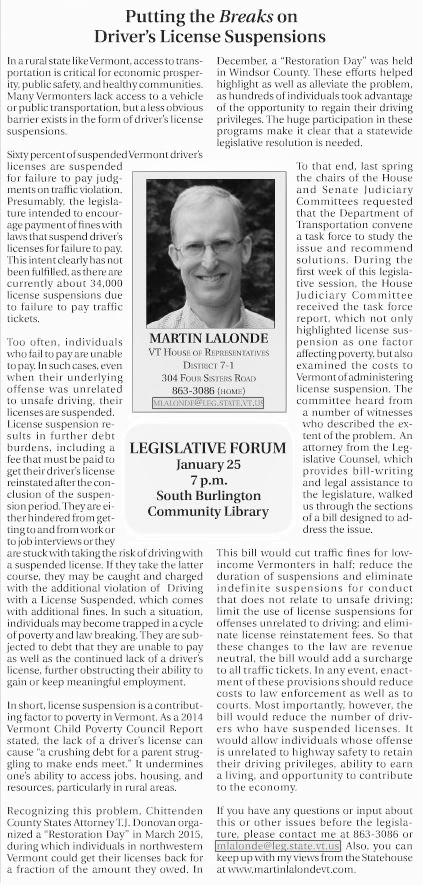
The Committee has also been examining the issue of driving with a suspended license. License suspension contributes to poverty in Vermont. Losing one’s license undermines the ability to access jobs, housing, and resources, particularly in rural areas. Sixty percent of suspended Vermont driver’s licenses are suspended for failure to pay judgments on traffic violations. Presumably, the legislature intended to encourage payment of fines with laws that suspend driver’s licenses for failure to pay. This intent clearly has not been fulfilled, as there are currently about 34,000 license suspensions due to failure to pay traffic tickets. These suspensions reflect a driver’s inability to pay rather than whether that driver can safely operate a vehicle on our public roads.
We are addressing this situation in H.571, which would cut traffic fines for low-income Vermonters in half; reduce the duration of suspensions and eliminate indefinite suspensions for conduct that does not relate to unsafe driving; limit the use of license suspensions for offenses unrelated to driving; and eliminate license reinstatement fees. So that these changes to the law are revenue neutral, the bill would add a surcharge to all traffic tickets. In any event, enactment of these provisions should reduce costs to law enforcement as well as to courts. Most importantly, however, the bill would reduce the number of drivers who have suspended licenses. It would allow individuals whose offense is unrelated to highway safety to retain their driving privileges, ability to earn a living, and opportunity to contribute to the economy.
Judiciary has also been reviewing metrics on state court performance relative to population-level outcomes. We have heard testimony from the court administrator related to caseload, throughput, and other statistics that show how the courts are doing in providing Vermonters access to justice. In short, the court system is currently challenged by the collateral consequences associated with opiate addiction, primarily in the Superior Court family division. The recent appointment of four additional judges and the implementation of a new case management system should alleviate these challenges.
The courts, and the Judiciary Committee that oversees the judicial system, sit at the end of the pipeline, dealing with the consequences of societal problems. The Secretary of Education provided an enlightening presentation to the Committee about how our schools are trying to deal with those problems early, so that the courts do not have to address them later. She explained how the State is working to reduce the incidence of suspensions and expulsions from school, which, if unaddressed, can become a pipeline to prison. Investment in initiatives such as early education and the use of restorative justice in schools can reduce the number of individuals entering this pipeline and reduce the costs of the court system.
Putting the Breaks on Driver’s License Suspensions
Pricing Carbon
During this coming session, one of the issues that I will follow closely is the legislature’s actions addressing climate change. Last session, along with a number of other representatives, I cosponsored H.412, a bill that would establish a carbon pollution tax. You can review my description of this bill in my End of Session Report, which I posted here on June 10, 2015. Herein, I describe the economics behind putting a price on carbon emissions.
Economists agree that putting a price on carbon is the ideal way to limit the greenhouse-gas emissions that cause climate change. When people engage in activities that release carbon, they impose a cost on others. For example, when someone drives a car, it burns gasoline, contributing to global warming and imposing costs on the public. That societal cost is not built into the price of gasoline, so the driver does not take it into consideration when starting up his or her car. A price on carbon would add the missing cost to the price of gas. The higher price, reflecting the societal costs, would give people an incentive to drive less and thus emit less carbon.
There are two primary methods for the government to establish a price for carbon. First, it can establish what is called a cap and trade system. The government can set a maximum level of acceptable carbon emissions and then issue tradable permits for quantities of carbon emissions. This allows the market for such permits to determine the price of carbon. Such a system has been used effectively in another context. In the 1990s, the federal government successfully used a cap and trade system to reduce emissions of sulphur dioxide from coal-fired power plants, thus reducing the incidence and impact of acid rain.
Also, in 2008, Connecticut, Delaware, Maine, Maryland, Massachusetts, New Hampshire, New York, Rhode Island, and Vermont implemented a cap and trade system called the Regional Greenhouse Gas Initiative. This initiative is intended to reduce the amount of carbon allowed from electricity producers, who are required to buy a credit for every metric ton of carbon they emit. In 2014, the Initiative’s cap was 91 million tons, with that cap declining by 2.5 percent each year from 2015 to 2020. It is too early to know how effective this initiative will be.
As an alternative to a cap and trade system, the government can establish a price through a tax on carbon. British Columbia, Canada has priced carbon through imposing a tax and carbon emissions have gone down with no discernible harm to the province’s economy.
H.412 would implement a system similar to that found in British Columbia. It would set a price on fuels that release carbon to more closely reflect the costs of carbon emissions to society. That would, in turn, provide incentive for consumers to reduce their use of carbon-emitting fuels. The revenues that are collected from the tax would be used to reduce other taxes and to fund energy efficiency efforts.
It is not clear whether this bill will advance out of the House Committee on Natural Resources this session. I am participating with the legislature’s climate caucus to determine how we may be able to advance this or other bills that will help address the causes of climate change. As always, I would appreciate any input on this or other issues in the legislature.
Distracted Driving – Lessons in Formulating a Bill
I have been tracking many issues while the legislature is not in session. I have reported on a number of them in my monthly columns in The Other Paper (see previous posts of these columns). I have also been working on a couple of bills that I intend to introduce in the coming session. One involves strengthening Vermont’s distracted driving laws. In this post, I will discuss this bill and the issue of distracted driving to give an overview of how a bill is generated. As I explain, producing a bill involves recognition of community interest in an issue, research into the problem and potential solutions, consultation with experts, and judgment as to what might gain traction in the legislature. I intend to write further about the progress of this issue and bill during the upcoming session.
In August, I heard from a constituent regarding a number of concerns related to traffic safety, including that the current distracted driving laws in Vermont prohibiting the use of handheld devices while driving are not effective. He drives a motorcycle and is vigilant in watching whether other drivers are paying attention. Too often, they are not. And often that inattentiveness is due to the use of mobile devices. He suggested to me that the legislature should significantly increase the penalties for violations to make the law effective as a deterrent.
I started to look into the issue and contacted the Vermont Office of Legislative Counsel for assistance in evaluating the problem and determining potential fixes to include in a bill. This Office provides the General Assembly with legal advice and bill-drafting services. In early September, an attorney was assigned to assist me.
To get me further grounded in the issue, the Legislative Counsel attorney explained the various laws that the State already has on the books. Over the past few years as smartphones have become more prevalent, the legislature has enacted a number of laws and amendments to those laws to address the dangers that the use of such devices cause on our roads.
Under these laws, anyone who is under 18 years old is banned from using any portable device in any manner while operating a motor vehicle. 23 V.S.A. § 1095a. For a violation of this provision an individual is subject to up to a $1,000 fine and 2 points on his or her license. He or she will receive a 90-day recall of his or her license after 6 points are accumulated. Note that a recall is different than a license suspension. At the end of a recall, an individual does not have to pay to get a license reissued, as one does after a suspension. Further, a recall is not carried on one’s record.
Individuals over 18 years of age operating a motor vehicle may use a portable electronic device “hands free,” but may not otherwise use such a device. 23 V.S.A. § 1095b. The penalty for a first offense of this provision is a $100 to $200 fine. If the offense occurred in a work zone, the driver is subject to receiving 2 points on his or her driving record. A second offense brings a $250 to $500 fine and, if in a work zone, 5 points. No points are imposed if the violation occurs outside a work zone. An adult operator who accumulates 10 points or more within a 2-year period is subject to a 10-day suspension of his or her license.
All drivers are banned from texting while operating a motor vehicle. 23 V.S.A. § 1099. If a driver violates this provision, he or she is subject to a maximum fine of $200 for the first offense and $500 for a second offense that occurs within two years. In addition, the driver is subject to receiving 5 points on his or her driving record. (There are separate restrictions for those who are commercial operators of motor vehicles.)
After this explanation, the legislative counsel and I discussed the perceived problem and possible solutions. We agreed that, as a next step, she would research the different means to improve the efficacy of the laws. She later provided me her findings, sharing abstracts from studies of the deterrent effect of various penalties on traffic violations. The main lesson I took from the research was that increasing the risk of detection and punishment for violators of the distracted driving laws would be more effective than simply increasing the penalty for violations.
The legislative counsel also provided statistics from the Vermont State Police related to ticketing for violation of these laws. The laws have not been in effect for very long, so the information was somewhat limited. Nevertheless, the data was sufficient to show an increase in ticketing for offenses involving the use of portable electronic devices, but no clear upward trend in texting tickets. The State Police contact noted, however, that no funds were available for measuring the incidence of cell phone use and texting while driving so it is difficult to make any accurate statements about the effect of the laws on driver behavior.
But I still felt that the effectiveness of our distracted driving laws was a problem. I agreed with my constituent that seeing people inappropriately using cell phones while driving is a common occurrence. A too-frequent occurrence.
On October 26, 2015, I attended a conference sponsored by the Vermont Highway Safety Alliance in Jay Peak. Among other things, I learned that statistics show that there has been a declining trend in major motor vehicle crashes in Vermont since 2006. But I also learned that crashes related to distracted driving are of substantial concern among traffic safety experts given the increasing use of portable devices in motor vehicles and of interactive information systems in most new cars. I spoke with police officers who told me that they remain concerned with distracted driving. They also indicated that the primary problem with enforcing the current laws is the difficulty in detecting violations. At the conference, I also established a contact with the Director of State Relations for AAA, which has been studying the impacts of distracted driving and follows legislative and regulatory proposals on traffic safety issues. (For further information, go to the recent AAA report, Measuring Cognitive Distractions).
Soon after the conference, the legislative counsel sent me an initial draft bill that focused on increasing the penalties for distracted driving, including doubling of fines. During this time, I had also been in contact with AAA and found out that Vermont’s penalties are actually a bit above the national average and that doubling fines would make them among the most severe in the country. I also learned that the doubled fines would be higher than just about any other fine that a passenger vehicle operator is likely to face. It became clear that perhaps other fines could be raised too, but if not, it was a fair question whether the idea of doubling the fines was appropriate.
On reflection, it seemed unlikely that I would be able to convince the legislature to increase all traffic fines. In any event, I was learning that simply increasing penalties was not likely to address the crux of the problem with the laws’ effectiveness. It was detection and enforcement that needed to be addressed.
I met with the legislative counsel in early November to hash out different ideas. We eventually settled on an approach that would be less reliant on an increase in penalties. Still, certain penalties would be strengthened. I decided to include in the draft bill enhanced penalties for violations in school zones similar to those that already exist in the law for violations in construction zones; introduction of points for a second violation outside such zones; and required automatic recall of licenses of junior operators for 30 days after one offense, 60 days for a second offense, and 90 days for a third offense. I also included in the draft bill a provision to expand the use of a current DUI Enforcement Special Fund to include efforts to address distracted driving.
The main thrust of the bill, however, is to improve law enforcement’s effectiveness at detecting violations. To accomplish this, the bill includes an “implied consent” provision that would allow an enforcement officer to search an operator’s portable electronic device for the limited purpose of enabling the officer to determine a violation of the distracted driving law, if the officer has reasonable grounds to believe that a violation occurred. To our knowledge, this would be a unique provision in a state’s distracted driving law. But it makes sense. When an individual is granted the privilege to drive on public roads, he or she has given implied consent to certain intrusions to ensure the safety of the roads. For instance, an officer on suspicion can ask a driver to undertake a breathalyzer test. The driver can refuse, but there are consequences. Similarly, it makes sense that an officer on suspicion can ask to see a portable device to confirm whether a driver has been inappropriately using that device. The driver can refuse but, again, such refusal would come with consequences.
After being satisfied with the draft bill, I ran it by other legislators who had expressed interest in the issue or related issues of road safety, my contact at AAA, and a representative of the Department of State’s Attorneys and Sheriffs, whom I had also consulted earlier about my work on the bill. I am still waiting to hear back from these contacts, although the State’s Attorneys representative did not have an issue with the concepts in the bill. Nevertheless, it is still possible that before I finalize the bill, I will further modify it based on input. Once the bill is introduced, I will provide a link to it on this website.
My next step will be to sign up cosponsors for the bill, talk to legislators on the House Transportation Committee that would initially take the bill up, and let interested organizations such as bicycle safety groups know that it is being introduced so they may push for its consideration. I am hopeful that this initiative will succeed in the upcoming session. I will report its progress in future posts.
Judiciary Committee Preview

Limits on Education Spending Growth

Restructuring School Districts
 Vermont State House Representative Martin LaLonde
You must be logged in to post a comment.