

Author: lalonde
Ensuring Access to Justice

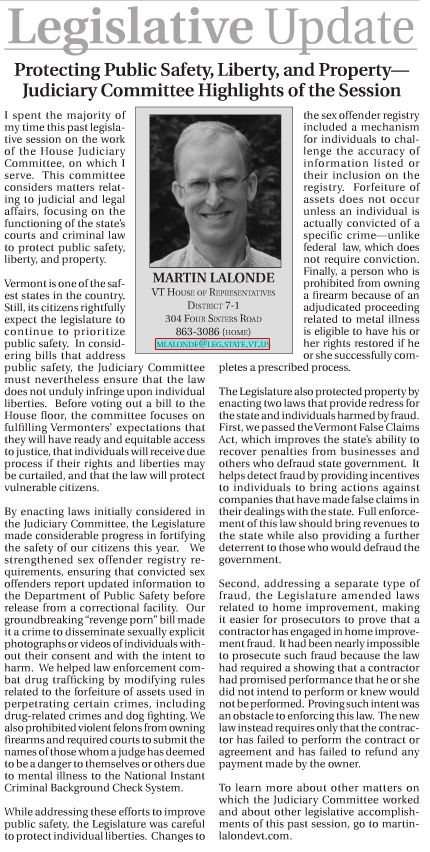
Protecting Public Safety, Liberty, and Property
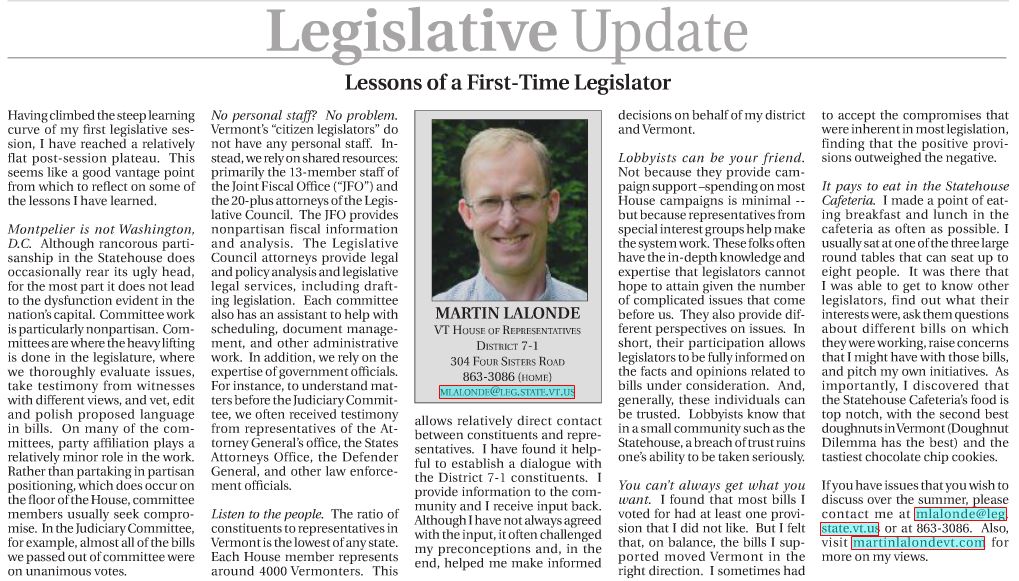
Lessons of a First-Time Legislator
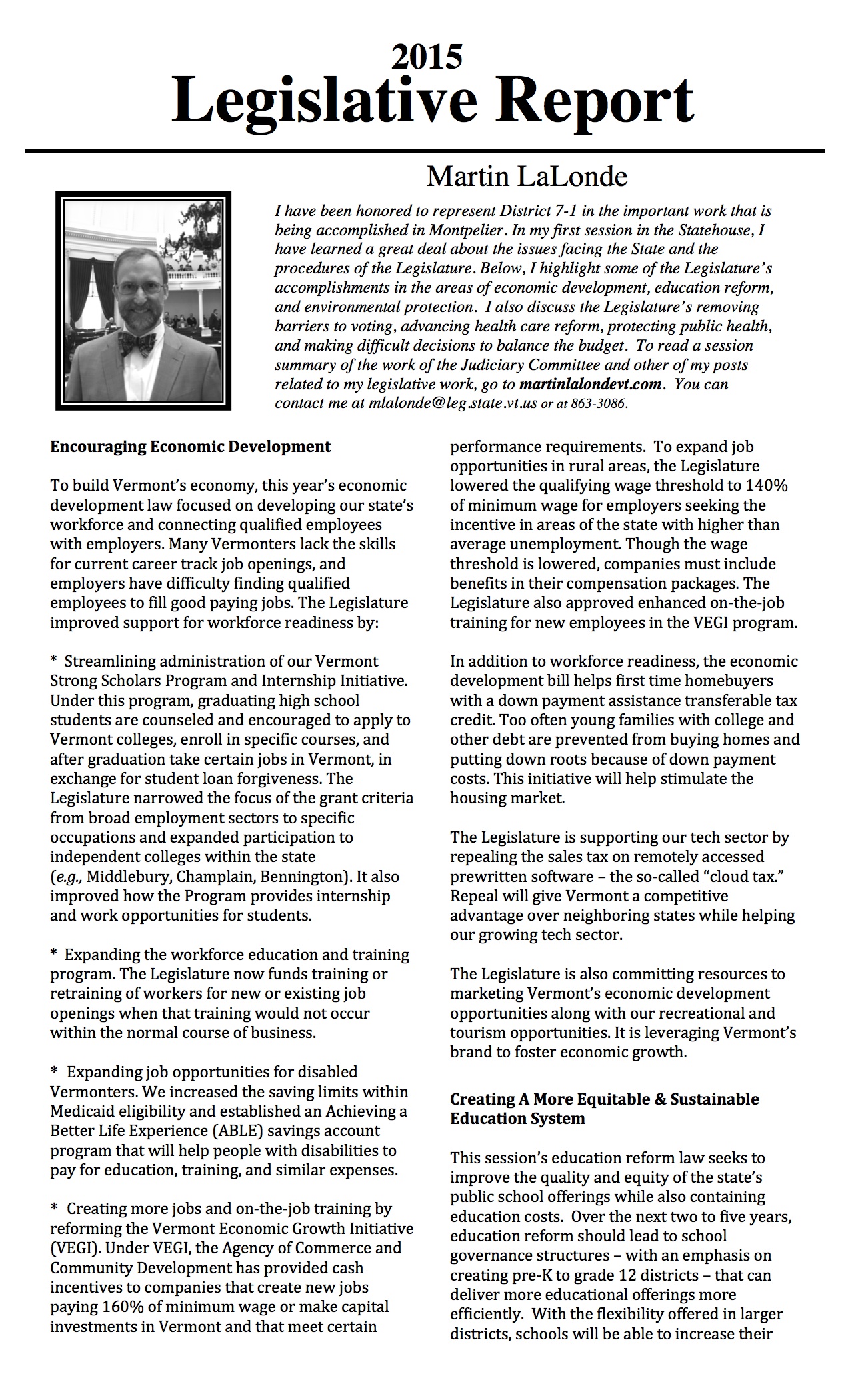
2015 Legislative Report

Judiciary Wrap Up
Although Vermont is one of the safest states in the country, its citizens still rightfully expect the legislature to continue to prioritize public safety. In considering bills that address public safety, the Judiciary Committee must also ensure that the law does not unduly infringe upon individual liberties and freedoms. The Committee seeks to fulfill Vermonters’ expectations that they will have ready and equitable access to justice, that individuals will receive due process if their rights and liberties may be curtailed, and that the law will protect vulnerable citizens. In addition to balancing these often-competing goals, the Committee focuses on many other aspects of the State’s judicial and legal affairs.
This session, to improve public safety, the legislature enacted a number of laws addressed by the Judiciary Committee. Act 1 strengthens aspects of the Sex Offender Registry, ensuring that a sex offender reports updated information for the Registry to the Department of Public Safety prior to his or her release from a correctional facility. H.105 makes it a crime to disseminate sexually explicit photographs or videos of individuals online without their consent and with intent to harm, even if the subject had consented to the taking of the photograph or video. S.102 assists law enforcement in its efforts to combat drug trafficking by modifying rules related to the forfeiture of assets used in perpetrating certain drug-related crimes. The Act also expands forfeiture rules related to dog fighting. Act 14 prohibits violent felons from owning firearms and requires state courts to submit to the National Instant Criminal Background Check System (“NICS”) the names of those whom a court has adjudged to be a danger to themselves or others due to mental illness.
While addressing these efforts to improve public safety, the legislature was careful to protect individual liberties. S.13 (a separate bill than Act 1) ensures that Sex Offender Registry information listed on the Internet is accurate. It also provides a mechanism for individuals to challenge the accuracy of information or their inclusion on the Registry. While S.102 allows forfeiture of assets used in the perpetration of certain crimes, it does not allow for such forfeiture to occur unless an individual is actually convicted of that crime. This contrasts with the federal forfeiture law, which allows for forfeiture when an individual is charged with certain crimes, whether or not convicted. Act 14 provides a procedure for individuals to have their name removed from the NICS database.
Criminal convictions often result in consequences for Vermonters beyond court-imposed penalties and sentences, particularly for felons. For example, even after serving their time and paying any imposed penalties, individuals who have been convicted suffer from an inability to obtain housing or employment due to their criminal records. In addition, incarceration for non-violent offenders is often costly and counterproductive.
Collateral consequences and counterproductive incarceration are particularly problematic for juvenile offenders. Current science shows that the brain continues to change and mature throughout childhood and adolescence. Due to the stage of their brain development, adolescents are more likely to act on impulse and misread or misinterpret social cues, and less likely to think twice, change their mind, or pause to consider the consequences of their actions. They are, in short, more likely than adults to make bad decisions and to violate criminal law. So long as their record follows them, juvenile offenders will suffer the consequences of their errors long after they have reached adulthood and completed the court-imposed punishment for the crime.
The legislature has enacted law that seeks to alleviate the problem of collateral consequences and counterproductive incarceration, particularly for juveniles. S.115 establishes a quicker path to expunging their criminal record for individuals who committed their crimes when younger than 25. H.62 prohibits sentences of life without parole for a person who committed his or her offense as a minor. Each of these bills await the Governor’s signature. The House also passed H.95, which seeks to ensure that States Attorneys file more cases in the Family Division of state court rather than in the Criminal Division when those cases involve juveniles. If filed in the Family Division, the juvenile’s record will not be public, thus collateral consequences from the conviction will not travel with him or her into adulthood. The Senate did not act on this bill in this session.
In addition, the Judiciary has taken testimony on a bill that seeks broader reform of Vermont’s criminal justice system. The bill would, among other changes, reduce the number of crimes punishable as felonies; eliminate jail time for non-violent offenders; prevent people from being kept in jail past the end of their sentence due to lack of housing; expand parole eligibility for individuals who have serious medical conditions, were sentenced for an offense committed as a juvenile, or are 65 years of age or older; and eliminate incarceration for violations of parole conditions that are not new crimes. Although the bill was not advanced in this session, such issues will likely be at the forefront of Judiciary’s work in the next session, when it continues to seek to rationalize the penalties for the various crimes in Vermont law, reduce unnecessary and costly incarceration rates, and minimize the collateral consequences of conviction.
During the current session, Judiciary also worked to improve protection of children. The Committee assisted with a major initiative of the General Assembly in light of the tragic deaths of two infants last summer. It took testimony on aspects of S.9 that related to criminal justice. Further, in H.86, the legislature enacted amendments to the Uniform Interstate Family Support Act, which assists with the enforcement of child support orders regardless of where a child lives.
The legislature also enacted a State False Claims Act (H.120), which provides for penalties for those who knowingly submit false or fraudulent claims to the State. Full enforcement of this law should bring revenues to the State while also providing a further deterrent to those who would defraud the government. Addressing a separate type of fraud, the legislature also amended laws related to home improvement. Act 13 makes it easier for prosecutors to prove that a contractor has engaged in home improvement fraud.
In short, the Judiciary Committee had a busy and productive session.
Difficult Decisions
During the course of this legislative session, I have had to make many decisions on how to vote, both in the Judiciary Committee and on the House floor. Many of those decisions have been relatively straightforward. Most of the bills have passed out of the Judiciary Committee on unanimous votes, and many have passed the House unanimously or nearly so.
Decisions on other votes, however, have been more difficult. Two such votes occurred this week, one on a bill to allow voter registration on the same day as voting and the other on a bill to eliminate the philosophical exemption for vaccination for children entering school.
Proponents of the same-day voter registration bill argue that voting is a fundamental right and any barriers to the exercise of that right should be eliminated. Easing the way to vote should bring more people to the polls, and a strong democracy depends on citizen participation. But others are opposed, claiming that same-day registration would make it too easy to register and vote, resulting in increased voter fraud. Elections tainted by voter fraud would undermine the very democratic ideals that free and open elections are supposed to serve.
The bill to eliminate the philosophical exemption for vaccination has been one of the more divisive of the session, as it involves the competing rights of individuals to make health care decisions and rights of a community to be protected from infectious diseases. Proponents and opponents of the philosophical exemption are passionate about the issue.
Proponents of the exemption allege that vaccines are risky and can harm children; it is too difficult to obtain a medical exemption from vaccination; vaccine manufacturers are not liable for the damages they incur and have little incentive to ensure the safety or effectiveness of their vaccines; and the state already has a high vaccination rate (94-98%) and a low rate of invocation of the philosophical exemption. They also assert that removing the exemption takes away the freedom and rights of parents to make educated decisions for their children in a situation where there is no imminent threat that requires the government to intervene.
Opponents of the exemption argue that scientific evidence overwhelmingly supports the safety and favorable risk-benefit ratio of vaccine administration. They reason that philosophical exemptions are associated with clusters of unvaccinated children and outbreaks of vaccine-preventable diseases; our current Vermont law not only contributes to rising rates of under-vaccinated children, but also puts others at risk, including children and adults with diseases or treatments that impact their immune system and those too young to be vaccinated; children, elderly, and immuno-compromised patients deserve to live in a place made safer by higher vaccination rates; parents do not have a right to put other children at risk by not vaccinating their own children; and once-vanquished diseases such as pertussis and measles are resurging as a result of declining vaccinations. In short, they assert that achieving high rates of vaccination in schools is a public health imperative to which individual choice should give way.
The decisions I had to make on these bills provide an opportune time to elaborate on my decision-making process in the legislature. There are many factors that go into my thinking when I decide how to vote.
One consideration is certainly the input that I receive from constituents. I do take into consideration the views that constituents express when they contact me or meet with me at my weekly sessions at the Panera on Shelburne Road. When I receive input from constituents, I do not simply count the pros versus the cons on the issue. I do not let the squeakiest wheel control my deliberation. Rather, I consider the arguments that constituents make and review the facts and supporting materials that they refer me to in order to arrive at my own conclusions.
Nevertheless, what my constituents might or might not think about an issue can only go so far in influencing my vote. It would not be possible for me to cast every vote in the legislature as the majority of my constituents might want me to in part because I simply cannot determine what that majority might think on each issue. Doing so would require me to poll District 7-1 each time a decision has to be made, which, of course, would be extraordinarily difficult if not impossible. Occasionally, however, a state-wide poll may be available on an issue, which can give a sense of where the broader community falls on a particular issue.
When considering certain bills, I also reach out to community members who I know have an interest in or expertise on an issue. For example, I spoke with Tom DiPietro, South Burlington’s Deputy Director of Public Works, to learn more about the city’s interests in the water quality bill the House considered earlier in the session. I also spoke with Donna Kinville, the South Burlington City Clerk, about same-day voter registration. I do not necessarily follow all of the advice that I receive from these community members, but I rely on them to help me make an informed decision.
On bills before the Judiciary Committee, I have the opportunity to gain detailed knowledge on the issues involved. The committee takes testimony from witnesses with various expertise, experiences, and viewpoints and committee members have the opportunity to ask them questions. We review materials that witnesses provide and that we locate through our own research. We receive guidance from attorneys of the Legislative Council and economists from the Joint Fiscal Office. In short, we become well versed in the issues related to the bills over which the Judiciary Committee has jurisdiction.
Because the issues that the legislature addresses are so varied, complicated, and numerous, it is not possible to delve as deeply into those bills that come through other committees. Accordingly, I must exercise a certain amount of deference to the judgment of the committees that investigate in depth the issues within their jurisdictions. This does not mean that I simply accept their judgments, although unanimous support for a bill from a bi- or tri-partisan committee does carry weight as to whether I will support its conclusion. To the extent possible, I seek to verify other committees’ conclusions and weigh the counterarguments. In doing so, and when I feel I need more information on the issue, I will also consider the viewpoints of experts and other witnesses from whom the committees have heard.
Typically, by the time a bill reaches the House floor and we are called upon to vote, my position on a topic has solidified. On other occasions, the debate on the House floor may crystalize an issue on which I am still wavering.
An additional factor that may influence my decision is politics. As a freshman legislator, I am still learning how this factor plays out. To date, I have not felt direct pressure from the leadership of the House or the Democratic Caucus to vote in a particular manner. But I also know that if I constantly vote against the majority, my ability to accomplish work on behalf of my constituents will be diminished. This session, I have voted against the party line on occasion. I sponsored an amendment to ban strikes and imposition in the context of teacher collective bargaining, despite the general opposition to this idea by the Democratic Caucus. But this has been one of the few instances where my own views have run counter to the party.
My votes this week on the bill that will allow residents to register to vote on election day and the bill that will eliminate the philosophical exemption for vaccination for children entering school provide examples of how I reach my voting decisions. I did not hear from any constituents on the same-day voter registration bill. I did, however, hear from the South Burlington Town Clerk, who opposed the bill. Primarily, she was concerned about the increased chances of voter fraud that she believes the bill will create. To alleviate this concern, she urged that individuals seeking same-day registration have an ID or other evidence of their residence.
I considered her input in my deliberations. The Government Operations Committee had also considered her input, which she had delivered in testimony, along with the input of other town clerks and the Vermont Municipal Clerks and Treasurers Association. The Committee sought to address these concerns by pushing off the effective date of the bill to January 2017 and requiring a study that would consider, among other issues, how other states with same-day voter registration address what type of proof of residency should be required by individuals seeking to register on election day.
In considering how to vote, I reviewed the rules related to voter registration in Vermont and the voter registration form. That form requires an individual to affirm that he or she meets the requirements to vote in the district: a United States citizen, a resident of the town in which he or she wishes to vote, and at least 18 years old. The individual must also take a voter’s oath. The form makes clear that giving false information as to one’s qualifications to be registered to vote in the town can result in penalties of up to $10,000 or imprisonment for not more than 15 years. I felt that the requirements and warnings set forth in this form would act as an adequate disincentive to most individuals who might consider trying to register fraudulently. I also reviewed reports and other evidence that had been provided to the Government Operations Committee and were available on its website that indicated the very low incidence of voter fraud.
From this review and from listening to the debate on the House floor, I was satisfied that the minimal risks of an increase in voter fraud did not outweigh the benefits of removing barriers to an individual’s ability to exercise his or her fundamental right to vote. I accordingly voted for the bill, which passed the House. In many states, Republican-controlled legislatures are introducing, not eliminating, barriers to voting, with the likely result of disenfranchising many impoverished and under-represented citizens. I’m proud that Vermont is taking a different approach.
In considering how to vote on the bill to eliminate the philosophical exemption, I considered the viewpoints of and facts offered by constituents, experts, and the Health Care Committee, and points made during the floor debate and in a packed public hearing. On this issue, I received more emails and calls from constituents than any other issue that has come before the legislature this session. All but one of these constituents urged me to vote to remove the philosophical exemption. I received emails from many other Vermonters including South Burlington residents outside District 7-1, many who sought to keep the exception in place. I also noted that a state-wide poll shows that over 70% of Vermonters support eliminating the exemption.
I reviewed materials that individuals referred me to and those that were available on the Health Care Committee’s website. On the one hand, I did empathize with many of the points that proponents of the exemption advanced, including their desire to make individual decisions that they viewed as in the best interest of their children. I was most troubled by the apparent difficulty that individuals face when they try to obtain medical exemptions to vaccinations.
On the other hand, I accept the scientific consensus that vaccines are safe and effective, a high vaccination rate is necessary to obtain so-called herd immunity in order to protect vulnerable individuals who are unable to be vaccinated, and the risks of harm from vaccinations are outweighed by the risks from infectious diseases that vaccinations protect against. I also was influenced by the fact that Vermont has one of the lowest vaccination rates in New England and that other surrounding states without the philosophical exemption have higher vaccination rates. The testimony of Vermont Health Commissioner Harry Chen and from a number of respected doctors supporting elimination of the exemption carried significant weight. Also, the bill modifies the provision relating to obtaining medical exemptions, making such exemptions easier to obtain. Moreover, by eliminating the philosophical exemption, doctors will need to consider patients’ requests for the medical exemption instead of simply advising them to exercise the philosophical exemption. Finally, during debate, I felt that those who supported eliminating the exemption were able to effectively answer all of the arguments in favor of keeping the exemption in place.
Ultimately, I was swayed by the view that individual liberties must be balanced against the responsibilities that individuals have toward the community in which they live and so I voted for the bill to eliminate the exemption, which bill passed the House. Having one’s children vaccinated before they enter school, unless one receives a medical exemption or invokes a religious exemption, is part of the responsibility that parents should undertake for the sake of the community’s public health.
These decisions were not easy, but in the end I think that they were in the best interest of my South Burlington constituents and Vermont.
I believe that voters gave me the honor of representing them because they expected that I would use my best judgment on the issues that are important to South Burlington and Vermont. They expect that I will evaluate the facts and policies that lie beneath the problems the legislature is asked to resolve, consider the proposed solutions and the consequences of those proposals, listen to and understand the input I receive from constituents, and use my experience and intelligence to arrive at what I believe to be the best outcome.
Health Care Bill

A Long Week in the House
As the legislative session winds down (about two weeks left), long hours and controversial bills have been the norm in the House.
This past Wednesday and Thursday, the House took up a bill related to the Patient Choice at End of Life law, also known as the Death With Dignity Act. That law, which was passed in the last biennium, provides immunity for doctors who prescribe medication for the purpose of hastening a patient’s death. The law provides a number of protections, among which are the requirements that the patient must make two oral requests for medication to be self-administered for the purpose of hastening the patient’s death; the patient must make a written request for such medication in the presence of two witnesses who are not interested persons (e.g., family members, acquaintances); a physician must determine that the patient is, in fact, terminally ill, is capable, and is making an informed and voluntary decision; and the physician must inform the patient of the patient’s diagnosis, prognosis, range of treatment options, availability of palliative or hospice care, and the probable result of taking the prescribed medicine. The law also provides that these protections would sunset on July 1, 2016. After these protections sunset, physicians would still be immune from prosecution for prescribing medications that would hasten death. Apparently, to get this law passed, this sunset provision was included to get the votes of certain lawmakers who did not want the state involved in the matter.
The bill before the House would repeal the sunset provision and thus would keep the protections in place. Before voting on whether the repeal should go to a third reading the House considered an amendment that would have repealed the law in its entirety. After long debate, this amendment was defeated by a 60 to 83 vote, and the bill then was passed to a third reading.
The next day several amendments were offered at third reading to modify certain requirements of the law and to impose additional reporting requirements. Most were defeated except for one directing the Department of Health to adopt rules to facilitate the collection of certain information. The bill then passed, thus the protections of the Act will be retained.
I did vote for the bill, as I think having some control over one’s end-of-life choice is important, so long as protections are in place that ensure the choice is appropriate and informed. Representative Komline summed it up well when she said at the close of debate that “They take this medication when the time for hope is over. They’re not choosing death. They’re just choosing the way they die.”
On Thursday, the House next took up S.9, a Child Protection Bill. I have provided a description of this bill in a previous post. When the bill was first introduced in the Senate, it included a provision that would have created a felony for failure to protect a child. This provision sparked significant controversy primarily because it could act as a disincentive for people to get involved in trying to protect children. The bill that passed excluded any new or enhanced crimes and overwhelmingly passed the House.
Also on Thursday, the House started its consideration of a health care bill. My next article for The Other Paper, which I will post on Thursday, will address the main aspects of this bill. Here, I will mention three aspects of the bill that The Other Paper article will not address.
First, the bill was amended to include tobacco substitutes (electronic cigarettes) in current law regulating the display, sale, and use of tobacco products. In addition, it imposed a tax on the sale of tobacco substitutes.
Second, the bill relies on revenues generated through expanding the sales tax to include sales of candy and soft drinks, increasing taxes on tobacco products, and imposing a meals tax on items purchased from vending machines. These taxes, and the tax on tobacco substitutes, are appropriate sources for funding health care reform. The prices of these products do not fully reflect their costs to society, namely in the increased costs of health care due to obesity and tobacco use. Taxing these products internalizes some of the external societal costs that they impose – it makes the price of the product more accurately reflect their true cost. In addition, by increasing their prices, their consumption and use should decrease, with the resulting decrease in health care costs.
Finally, the bill includes provisions establishing performance milestones for Vermont Health Connect (“the Exchange”). Among these milestones will be the delivery of functioning technology by May 31, 2015 that addresses change of circumstances, and delivery of a fully automated system by October 1, 2015 that allows for 2016 plan enrollment. The bill provides for the independent review of the Exchange by the Joint Fiscal Office and requires the Agency of Administration to explore alternatives to the Exchange in the event the General Assembly decides to seek an alternate path to Vermont Health Connect.
Fortunately, it was not all controversy and work this past week. On Wednesday morning, I sang the devotional with the Statehouse Singers (see prior post). And on Thursday evening, after 10 hours on the House Floor, I participated in the annual Cabaret. This fund raising event features skits, jokes and songs performed by representatives, senators, and Statehouse staff, poking fun at each other and our work. I played guitar and sang a solo, the Gun Bill Blues, sang to the tune of Fulsome Prison Blues, and accompanied Judiciary Committee members in a tune about gaining weight over the course of the Session because of eating too many snacks in the Committee room. After a long, tiring day, the event was a welcome respite.
Statehouse Singers
It’s not all serious business in the Statehouse. This past week, I joined the Statehouse Singers to perform Turn the World Around. View the performance here.
 Vermont State House Representative Martin LaLonde
You must be logged in to post a comment.