Week Five – An Update on Judiciary Committee Matters

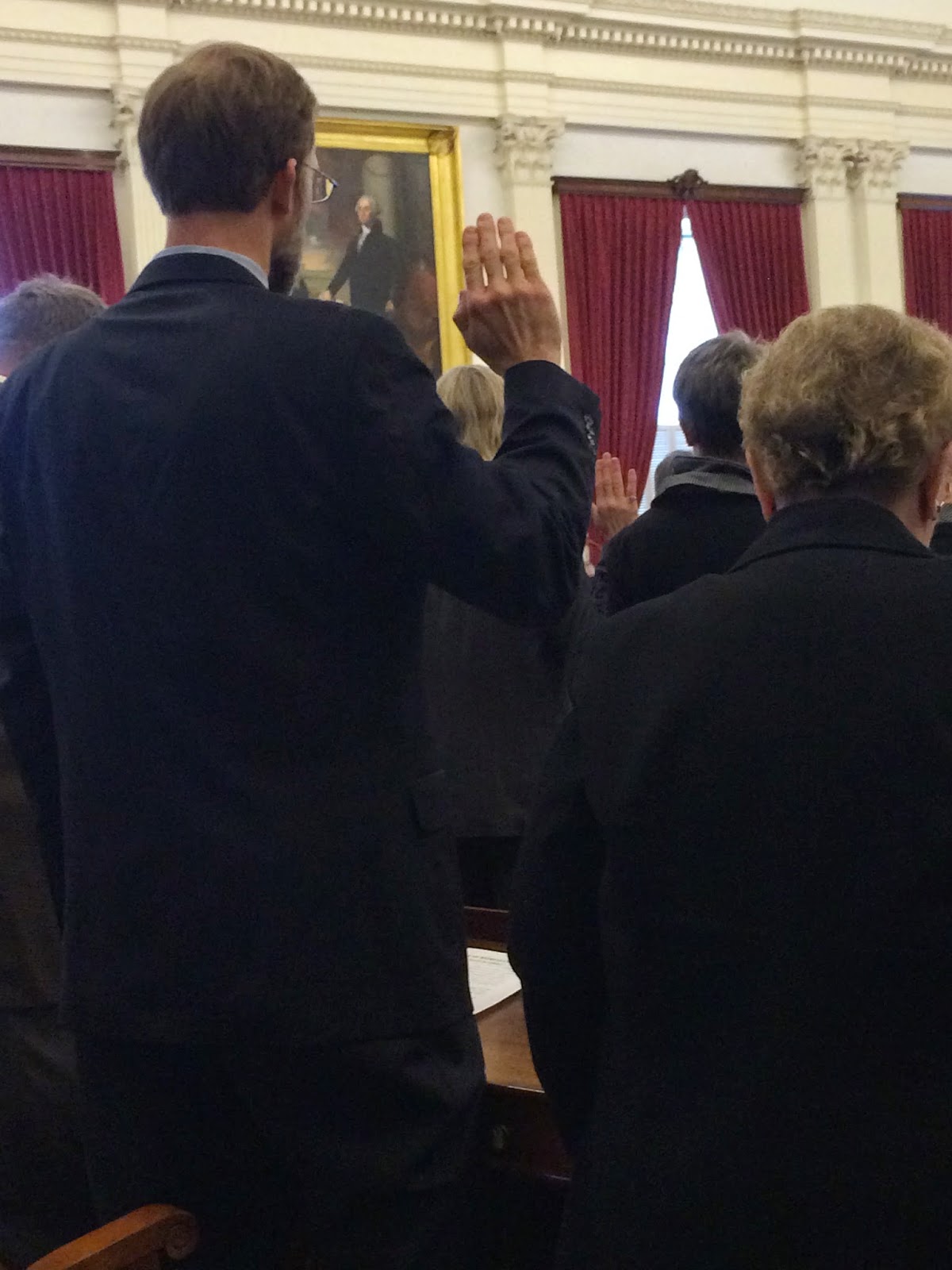
The past week in the legislature has been a full one on many different fronts. I worked on issues that came before the House Judiciary Committee, tracked the action on education funding reform, introduced my own bill related to collective bargaining between school boards and teachers associations, continued to follow potential legislation addressing the cleanup of Lake Champlain and climate change, and tried to continue to be aware in a general sense of the many other issues that are coming before the legislature.

Over the past two weeks, the House Judiciary Committee has heard testimony on and delved into issues related to juvenile justice. It considered H.62, which would prohibit sentences of life without parole for a person who committed his or her offense as a minor. Currently no inmates are serving such a sentence in Vermont. Nevertheless, enactment of the bill would recognize that, because their brains are not fully developed, juvenile offenders are less culpable and have the unique ability to be rehabilitated. Eliminating this harsh sentence would not excuse a juvenile’s behavior, but would provide the opportunity for such an offender to demonstrate rehabilitation to a parole board.

House Judiciary also considered H.95, which relates to jurisdiction over delinquency proceedings by the Family Division of the Superior Court. The objective of the bill is to channel more cases involving juveniles into the Family Division of state court, where certain confidentiality and other procedural protections are in place, rather than adult criminal court, which lacks such protections. The Committee received mixed testimony, the primary concern being whether the Family Division would have the resources to hear these additional cases. Currently, the judicial branch, and in particular the Family Division of state court, lack sufficient resources to keep up with caseloads that have been increasing due to the fallout from the opiate addiction problem in Vermont. Accordingly, we are paying close attention to this resource crunch when considering bills that would expand the number of cases that come before the state courts, particularly the Family Division.

During the course of hearing testimony on these bills, the Committee received interesting and enlightening testimony related to brain development. Current science on this topic supports our efforts to ensure that Vermont’s criminal justice system is appropriately handling juvenile offenders.

The Committee also considered H.105, which would amend the State’s laws related to voyeurism to impose criminal sanctions on individuals who disseminate sexually explicit photographs or videos of individuals online without their consent, even if the photograph or video itself was taken with consent – so-called revenge porn. Websites created specifically for this type of pornography sometimes include a victim’s name, address, and links to social media profiles with the images, and some websites charge a fee to have the materials removed. H.105 is different than laws adopted in most other states in that it also imposes sanctions on dissemination of digitally-altered sexually explicit images of another person without their knowledge and consent. The Committee will hear additional testimony in the coming week, including testimony addressing concerns related to First Amendment protections, particularly with respect to digitally-altered images.

House Judiciary also voted H.86 out of committee. H.86 will amend the Uniform Interstate Family Support Act (“UIFSA”), originally enacted in Vermont in 1996. The Act sets forth jurisdictional rules and determines which state’s law applies when more than one state is involved in establishing, enforcing or modifying a child support or spousal order, or is establishing a child’s parentage. UIFSA requires that every state defer to child support orders entered by courts of the child’s home state. Modifications to a support order may occur only in the home state unless the child and parents no longer live there. Custodial parents may request either directly or through the state agency responsible for child support that another state enforce the support order. I will take on the responsibility of reporting out this bill to the full House this coming week. That involves explaining the bill on the floor of the House and responding to any questions.

In addition to my work on the Judiciary Committee, this past Thursday I introduced H.102, “an act relating to labor relations for teachers and administrators,” which is a bill that I have worked on since early December. In an article that will be published this Thursday in The Other Paper, I describe my work on that bill. I’ll post the article next week.

On a lighter note, this past week I discovered that the Statehouse Cafeteria serves up excellent homemade chocolate chip cookies. I already knew that their chef makes the best cake doughnuts in Vermont, if not in all of New England. I, however, am trying to behave and keep my consumption of these delights to a minimum or else I will put on an extra ten pounds by the end of the session.

First Four Weeks in the Legislature

My first four weeks in the Vermont House of Representatives have been illuminating, engaging, and energizing. I am quickly learning the protocols and procedures of Vermont lawmaking and familiarizing myself with the many challenges facing the legislature this session.

The Vermont General Assembly is considering a number of complex and potentially divisive issues, including child protection, education governance and funding, health care reform, production of a balanced budget for the next fiscal year, Lake Champlain cleanup, job growth, marijuana legalization, and mandated universal background checks for gun purchases. I am trying to keep tabs on these and other issues. Nearly seven hundred bills will likely be introduced during this session, though only a small percentage of those will actually become law.

I have jumped right into my duties on the House Judiciary Committee, co-sponsoring two pieces of legislation related to child support. One bill, H.85, would allow the Office of Child Support (“OCS”) to notify individuals electronically of administrative actions regarding enforcement of support orders. This bill is currently stalled as OCS reconsiders its approach after the Committee expressed a number of concerns at a hearing on the bill earlier this week. The second bill, H.86, would extend the Uniform Interstate Family Support Act to other countries that are members of a convention signed in 2007. The Committee will hear further testimony on that bill next week and may vote to send it to the House floor. I expect that it will pass the House, then move to the Senate for consideration. The bills I sponsor appear on my House Legislative web page here.

The Judiciary Committee has broad jurisdiction and deals with myriad issues. Bills already before the Committee involve adverse possession, transfers of property to minors, prohibition of life sentences without parole for minors, and jurisdiction over delinquency proceedings in the family court. My legal background has proved to be invaluable in understanding the issues before the Committee and in interpreting the language of proposed legislation.

With eight out of eleven members new to the Committee, we spent time during the first weeks of the session familiarizing ourselves with the issues, laws, and governmental and other organizations that come before it. Among others, we heard introductory testimony from Vermont’s Attorney General and Defender General, the Chief Justice of the Vermont Supreme Court, the Executive Director of the Vermont Bar Association, the Commissioner of the Department of Children and Families, the State’s Attorneys’ Office, several legislative liaisons from law enforcement, and a number of nongovernmental organizations. Here is a link to the Committee’s web page and its daily agendas.

One presentation before the Committee was particularly surprising and disturbing. Yesterday, we heard from officers of the Department of Homeland Security, the U.S. Border Patrol, and the Vermont State Police on matters related to human trafficking; here is a link to a news story on the topic. We learned that trafficking of women for prostitution is a growing problem in Vermont and is frequently linked to the drug trade and addiction. We are not likely to see any bills on the issue this session; the State Police Officer specifically said that law enforcement does not want to see any changes to the law, as it currently provides the correct framework for their efforts. He did, however, emphasize that the legislature needs to continue to provide resources for addiction treatment to help the victims of human trafficking.

Last week the House passed the first bill, H.16, that was voted out of the Judiciary Committee this session. H.16 requires certain inmates to report to the Sex Offender Registry before their release from a correctional facility. It specifically addresses a small number of offenders who are “maxing out,” or leaving a corrections facility without any further supervision or contact with the Department of Corrections (“DOC”). This was what is called a technical correction bill because it merely codified current practice, though the DOC and others testified that it is best to have it clear in the law.

A bill to which the Committee will likely give significant attention started in the Senate and should arrive on House Judiciary’s doorstep in mid-February. S.9 is a multifaceted bill addressing child protection matters. The bill came out of a joint committee that met before the session started following the deaths last year of two young children in families that the Department of Children and Families were working with. The House Judiciary Committee participated in joint hearings with the House Human Services, Senate Health & Welfare, and Senate Judiciary committees to receive background information on S.9.

Besides my duties on the Judiciary Committee, I have been working on a bill related to collective bargaining between school boards and teacher associations. I worked with the Office of Legislative Council to put my ideas related to the fact finding process and arbitration into a draft bill and then lobbied other legislators to co-sponsor the bill with me. It will be introduced next Tuesday and I am to present the concepts behind the bill to the General, Housing & Military Affairs Committee, which takes up bills related to labor laws. I will discuss this bill in more depth in a future post. In the meantime, here is a link to a newscast where I am briefly discussing the idea behind it.

Because Chittenden District 7-1 abuts Lake Champlain, I am also keeping track of how the legislature is addressing the cleanup of Vermont’s waters. I have been attending weekly information meetings of the Water Caucus, a group of House and Senate legislators who are interested in this particular problem and solutions, and I have been following introduced bills related to the issue.

It’s not all toil in the Vermont Capital. I have joined the Statehouse Singers, a group of legislators and statehouse staff who meet for short rehearsals during the session. Yesterday, for the devotional (a daily poem, homily, or music), the Statehouse Singers sang Vermont’s State Song, These Green Mountains. The acoustics in the chamber are fabulous and I have to say we sounded great.

Announcement of Candidacy

Martin LaLonde announced his candidacy for the Vermont House of Representatives from Chittenden District 7-1, which encompasses the southwest section of South Burlington. LaLonde, his wife Anne and their two children, Griffin (15) and Tess (12), are residents of Four Sisters Road.

“I am seeking election to the Vermont House to use my experience in law, education, and natural resources issues for the benefit of South Burlington residents and all Vermonters,” LaLonde said.

LaLonde, age 50, is an attorney educated at the Michigan Law School, Michigan Business School, and Alpena Community College. Upon graduating from law school, he worked for a federal appellate court judge and a federal trial court judge. LaLonde then became a trial attorney in the Environment and Natural Resources Division of the Department of Justice in Washington, D.C., where he worked for 13 years. In 2007, already knowing Vermont from spending time here for vacations and family gatherings, LaLonde and his wife decided to move here to raise their family.

LaLonde has been active in the South Burlington educational community, including volunteering extensively at his children’s elementary school, where he and his wife in 2013 received the South Burlington Educators Association Layman’s Award for service to the school. He has been a mentor at the Orchard School and assisted in building sets for this year’s middle school plays. LaLonde is currently serving his second three-year term on the District’s School Board and is also on the Board of the Vermont School Boards Association.

“Educational policy is certainly one of my passions,” LaLonde explained. “My wife and I have found the public education offered in this community to be excellent and I have worked to maintain that excellence as a member of the School Board. But I feel that some of the greatest challenges our schools face, both here in South Burlington and throughout the State, will need to be addressed at the State level.” Among these challenges are how the state should fund education and whether and how the state’s school governance should change. “In Montpelier,” LaLonde said, “I hope to be able to use my experience to ensure that Vermonters have first-rate educational opportunities, from pre-kindergarten through college, at a cost the State’s taxpayers can afford.”

“Vermont’s exemplary schools help attract businesses to the State,” LaLonde continued, “and this and economic development initiatives will help Vermont thrive.” LaLonde’s view of how smart growth can occur has been informed by his participation on the South Burlington Form Based Code Committee, which has been drafting an update to the land development regulations for City Center – part of which is included in a tax increment financing (“TIF”) district. “I have learned a lot from this process – the importance of gathering diverse view-points from the real estate and development community, neighborhood and school district representatives, and environmentalists to come to a consensus on how growth should occur; and using incentives such as the TIF district designation to stimulate economic development. I would look forward to taking these lessons to the State House.”

LaLonde believes that growth in employment opportunities in Vermont is crucial, while at the same time emphasizing protection of the state’s natural resources. “I went to law school in 1990 specifically due to my interest in environmental issues,” LaLonde said. “During thirteen years defending the federal government’s land management agencies such as the National Park Service, Forest Service, Minerals Management Service and others, I learned to navigate the conflicts between conservation and using our natural resources.” LaLonde believes that this experience and his immersion in environmental policy issues would serve him well as a member of the Vermont House.

LaLonde also looks forward to the challenges involved in the complicated and controversial issues involved in health care reform. He believes that quality health care for all Vermonters is an imperative – and to achieve that goal will require figuring out how the financing can and will work. “While this is not yet an area of my expertise,” LaLonde said, “I have the skills and commitment to help craft a solution that will work for Vermonters and Vermont’s businesses. It should be quite an interesting couple years for the legislature dealing with this issue.”

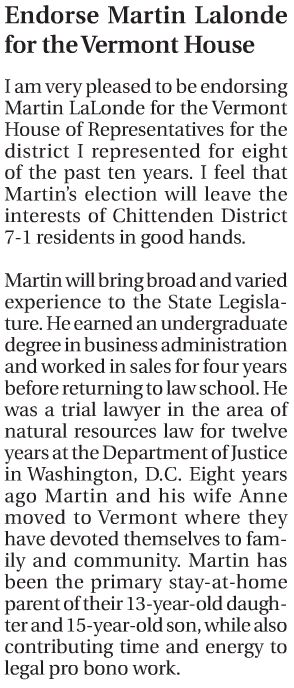
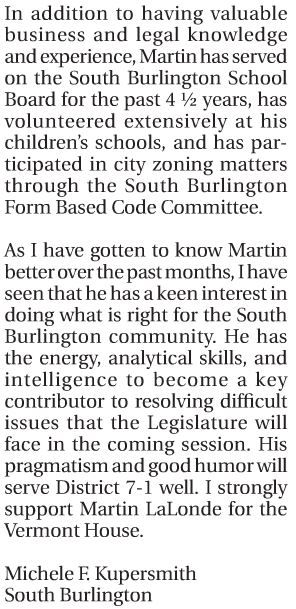
The current representative for Chittenden District 7-1, Michele Kupersmith, has decided not to seek another term. She will be LaLonde’s campaign treasurer. “She has done an outstanding job for the district,” LaLonde said. “If elected, I will do my best to carry on her tradition of community engagement and working for Vermonters from all walks of life.”

LaLonde has had the privilege and good fortune of being the primary at-home parent in the LaLonde household. He has found time outside his stay-at-home dad duties to enjoy Vermont’s beauty through biking, cross country skiing, and watercolor painting. He has also had the opportunity to indulge his love of music through learning to play the guitar, singing with his daughter, and listening to his son play the piano and his daughter play the violin. “My family and I have a good life here in Vermont. With my kids settled in at high school and middle school, I am eager to become further involved as a State Representative in making Vermont even better for all of us.”