
Yesterday I had the opportunity to share my views in “Under the Golden Dome,” a program produced weekly during the legislative session and named after the distinctive gold leaf on the dome of the Vermont capitol building. In the program, legislators discuss current events in the State House. I spoke about the effort to improve water quality in Lake Champlain as well as recent undertakings by the Judiciary Committee. You can watch the video here. My portion begins five minutes and twenty-seven seconds into the video.
Author: lalonde
Reporting out H.86, and other week six highlights
When a bill is first introduced in the House, it is called the first reading, even though the bill is note actually read aloud. At that time, the clerk of the House reads out just the title of the bill and the Speaker assigns it to a committee. Not all bills assigned to committees are acted upon during a session. If and when it does decide to take the bill up, the committee will hear from the sponsor of the bill and will take testimony from witnesses. The bill may still die in committee. Alternatively, the bill may be voted out of the committee, with or without amendments to the bill’s language as introduced. It will then go before the full House for the second reading, again not actually a reading. At the second reading, a legislator from the committee that has considered the bill will report it out, which entails explaining the bill on the floor of the House – its purpose, its provisions, why it should be passed, etc.
On Wednesday of this past week, I had my first opportunity to report out a bill, H.86, which is an amendment to the Uniform Interstate Family Support Act (“UIFSA”). Here is a photo of me reporting out the bill.
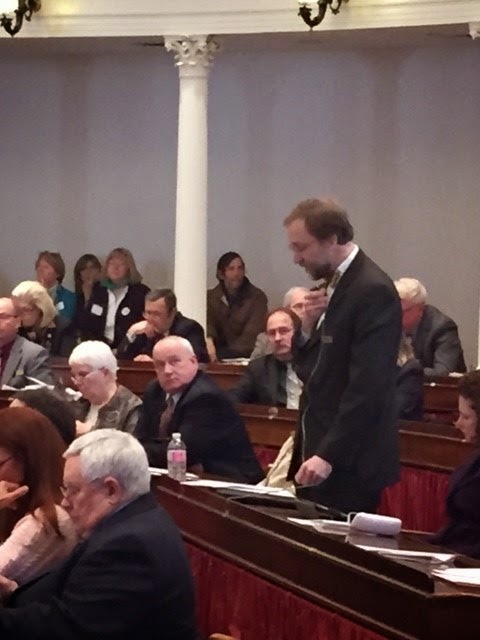
As I explained to the rest of the representatives, H.86 amends UIFSA, originally enacted in Vermont in 1996. UIFSA establishes uniform rules for interstate enforcement of both child support and spousal support orders. The law has two overall goals: first, there should be one support order between parties that is controlling at any given point in time, and second, the terms of the support order should be readily enforceable in any state.
It is important to have uniform laws in this subject area because families move. UIFSA helps to ensure that children are being supported when a noncustodial parent owing support resides in a different state than the child. There are roughly 15 million child support cases nation wide and about half of these involve parents in different states or countries.
Increasingly, it is important to have more uniformity not just among states, but also among countries. To that end, in November 2007, the United States signed a treaty establishing uniform procedures for processing international child support cases. The Uniform Law Commission, a non-partisan organization that drafts uniform laws in areas of state law where uniformity is important, incorporated the requirements of the treaty into proposed amendments to UIFSA. In order for the treaty to go into effect in the United States, all 50 states must enact these amendments. They must do so or risk losing federal funds that support state child support programs. Failure to enact these amendments during the 2015 legislative session could result in Vermont’s annual loss of $56 million in federal funds. Enacting the UIFSA would not only ensure continued receipt of federal help for Vermont’s child support enforcement efforts, but would also improve the enforcement of Vermont child support orders abroad and ensure that children residing in Vermont will receive the financial support due from parents, wherever the parents reside.
After I explained this in my reporting out of the bill, other members had the opportunity to “interrogate” me by asking questions about the bill, or could make statements in support of or in opposition to the bill. In the case of H.86, no one interrogated me or made statements. It was a noncontroversial bill, plus a significant amount of federal funds rides on enacting the UIFSA amendments. After the opportunity to interrogate, the House voted unanimously to approve the bill for a third reading. After the vote, as I learned is traditional, a number of legislators had pages deliver notes to me congratulating me on my first opportunity to report out a bill – another example of the collegiality of the House.
Between the second and third reading, legislators have the opportunity to seek amendments to the bill. There were no amendments to H.86, and on Thursday, the third reading was held and, again, the bill was passed unanimously and has been moved to the Senate for its consideration.
Although preparing for reporting out H.86 took up quite a bit of my time last week, I was also involved with other matters. The Judiciary Committee took testimony on a number of bills, but spent most of its time considering a State False Claims Act, which provides incentives for individuals to report fraud or false claims of companies in their dealings with state government. It also took testimony on bills related to “revenge porn,” and whether cases involving minors should be filed in the family or criminal division of state court (see last week’s post for more information regarding these latter two bills).
In addition, I tried to keep up on other areas of interest. I attended the climate caucus, which is an informal gathering of legislators from all parties and from both the Senate and House who are interested in this particular topic. I also attended a gathering of legislators interested in rural economic development. Finally, I spoke with the chair of the House General, Housing and Military Affairs Committee, which is considering the bill that I introduced related to teacher collective bargaining. We discussed the status of the bill and a related bill and what additional testimony might be helpful. See my most recent article for The Other Paper, which I posted yesterday, for more information on this bill.
On a lighter note, the Friends of the Vermont State House, a citizen’s advisory committee, held a fundraiser during the week. They sold Valentine’s Day cards with Statehouse themes and provided the services of a calligrapher to write notes in the cards. I believe Anne, Griffin, and Tess each enjoyed receiving the beautifully inscribed cards today along with chocolate hearts that I purchased at a top-notch chocolatier in Montpelier. Happy Valentine’s Day.
Changing Education Collective Bargaining
My Other Paper article on February 12 describes my firsthand experience with the Vermont legislative process.

Week Five – An Update on Judiciary Committee Matters
The past week in the legislature has been a full one on many different fronts. I worked on issues that came before the House Judiciary Committee, tracked the action on education funding reform, introduced my own bill related to collective bargaining between school boards and teachers associations, continued to follow potential legislation addressing the cleanup of Lake Champlain and climate change, and tried to continue to be aware in a general sense of the many other issues that are coming before the legislature.
Over the past two weeks, the House Judiciary Committee has heard testimony on and delved into issues related to juvenile justice. It considered H.62, which would prohibit sentences of life without parole for a person who committed his or her offense as a minor. Currently no inmates are serving such a sentence in Vermont. Nevertheless, enactment of the bill would recognize that, because their brains are not fully developed, juvenile offenders are less culpable and have the unique ability to be rehabilitated. Eliminating this harsh sentence would not excuse a juvenile’s behavior, but would provide the opportunity for such an offender to demonstrate rehabilitation to a parole board.
House Judiciary also considered H.95, which relates to jurisdiction over delinquency proceedings by the Family Division of the Superior Court. The objective of the bill is to channel more cases involving juveniles into the Family Division of state court, where certain confidentiality and other procedural protections are in place, rather than adult criminal court, which lacks such protections. The Committee received mixed testimony, the primary concern being whether the Family Division would have the resources to hear these additional cases. Currently, the judicial branch, and in particular the Family Division of state court, lack sufficient resources to keep up with caseloads that have been increasing due to the fallout from the opiate addiction problem in Vermont. Accordingly, we are paying close attention to this resource crunch when considering bills that would expand the number of cases that come before the state courts, particularly the Family Division.
During the course of hearing testimony on these bills, the Committee received interesting and enlightening testimony related to brain development. Current science on this topic supports our efforts to ensure that Vermont’s criminal justice system is appropriately handling juvenile offenders.
The Committee also considered H.105, which would amend the State’s laws related to voyeurism to impose criminal sanctions on individuals who disseminate sexually explicit photographs or videos of individuals online without their consent, even if the photograph or video itself was taken with consent – so-called revenge porn. Websites created specifically for this type of pornography sometimes include a victim’s name, address, and links to social media profiles with the images, and some websites charge a fee to have the materials removed. H.105 is different than laws adopted in most other states in that it also imposes sanctions on dissemination of digitally-altered sexually explicit images of another person without their knowledge and consent. The Committee will hear additional testimony in the coming week, including testimony addressing concerns related to First Amendment protections, particularly with respect to digitally-altered images.
House Judiciary also voted H.86 out of committee. H.86 will amend the Uniform Interstate Family Support Act (“UIFSA”), originally enacted in Vermont in 1996. The Act sets forth jurisdictional rules and determines which state’s law applies when more than one state is involved in establishing, enforcing or modifying a child support or spousal order, or is establishing a child’s parentage. UIFSA requires that every state defer to child support orders entered by courts of the child’s home state. Modifications to a support order may occur only in the home state unless the child and parents no longer live there. Custodial parents may request either directly or through the state agency responsible for child support that another state enforce the support order. I will take on the responsibility of reporting out this bill to the full House this coming week. That involves explaining the bill on the floor of the House and responding to any questions.
In addition to my work on the Judiciary Committee, this past Thursday I introduced H.102, “an act relating to labor relations for teachers and administrators,” which is a bill that I have worked on since early December. In an article that will be published this Thursday in The Other Paper, I describe my work on that bill. I’ll post the article next week.
On a lighter note, this past week I discovered that the Statehouse Cafeteria serves up excellent homemade chocolate chip cookies. I already knew that their chef makes the best cake doughnuts in Vermont, if not in all of New England. I, however, am trying to behave and keep my consumption of these delights to a minimum or else I will put on an extra ten pounds by the end of the session.
First Four Weeks in the Legislature
My first four weeks in the Vermont House of Representatives have been illuminating, engaging, and energizing. I am quickly learning the protocols and procedures of Vermont lawmaking and familiarizing myself with the many challenges facing the legislature this session.
The Vermont General Assembly is considering a number of complex and potentially divisive issues, including child protection, education governance and funding, health care reform, production of a balanced budget for the next fiscal year, Lake Champlain cleanup, job growth, marijuana legalization, and mandated universal background checks for gun purchases. I am trying to keep tabs on these and other issues. Nearly seven hundred bills will likely be introduced during this session, though only a small percentage of those will actually become law.
I have jumped right into my duties on the House Judiciary Committee, co-sponsoring two pieces of legislation related to child support. One bill, H.85, would allow the Office of Child Support (“OCS”) to notify individuals electronically of administrative actions regarding enforcement of support orders. This bill is currently stalled as OCS reconsiders its approach after the Committee expressed a number of concerns at a hearing on the bill earlier this week. The second bill, H.86, would extend the Uniform Interstate Family Support Act to other countries that are members of a convention signed in 2007. The Committee will hear further testimony on that bill next week and may vote to send it to the House floor. I expect that it will pass the House, then move to the Senate for consideration. The bills I sponsor appear on my House Legislative web page here.
The Judiciary Committee has broad jurisdiction and deals with myriad issues. Bills already before the Committee involve adverse possession, transfers of property to minors, prohibition of life sentences without parole for minors, and jurisdiction over delinquency proceedings in the family court. My legal background has proved to be invaluable in understanding the issues before the Committee and in interpreting the language of proposed legislation.
With eight out of eleven members new to the Committee, we spent time during the first weeks of the session familiarizing ourselves with the issues, laws, and governmental and other organizations that come before it. Among others, we heard introductory testimony from Vermont’s Attorney General and Defender General, the Chief Justice of the Vermont Supreme Court, the Executive Director of the Vermont Bar Association, the Commissioner of the Department of Children and Families, the State’s Attorneys’ Office, several legislative liaisons from law enforcement, and a number of nongovernmental organizations. Here is a link to the Committee’s web page and its daily agendas.
One presentation before the Committee was particularly surprising and disturbing. Yesterday, we heard from officers of the Department of Homeland Security, the U.S. Border Patrol, and the Vermont State Police on matters related to human trafficking; here is a link to a news story on the topic. We learned that trafficking of women for prostitution is a growing problem in Vermont and is frequently linked to the drug trade and addiction. We are not likely to see any bills on the issue this session; the State Police Officer specifically said that law enforcement does not want to see any changes to the law, as it currently provides the correct framework for their efforts. He did, however, emphasize that the legislature needs to continue to provide resources for addiction treatment to help the victims of human trafficking.
Last week the House passed the first bill, H.16, that was voted out of the Judiciary Committee this session. H.16 requires certain inmates to report to the Sex Offender Registry before their release from a correctional facility. It specifically addresses a small number of offenders who are “maxing out,” or leaving a corrections facility without any further supervision or contact with the Department of Corrections (“DOC”). This was what is called a technical correction bill because it merely codified current practice, though the DOC and others testified that it is best to have it clear in the law.
A bill to which the Committee will likely give significant attention started in the Senate and should arrive on House Judiciary’s doorstep in mid-February. S.9 is a multifaceted bill addressing child protection matters. The bill came out of a joint committee that met before the session started following the deaths last year of two young children in families that the Department of Children and Families were working with. The House Judiciary Committee participated in joint hearings with the House Human Services, Senate Health & Welfare, and Senate Judiciary committees to receive background information on S.9.
Besides my duties on the Judiciary Committee, I have been working on a bill related to collective bargaining between school boards and teacher associations. I worked with the Office of Legislative Council to put my ideas related to the fact finding process and arbitration into a draft bill and then lobbied other legislators to co-sponsor the bill with me. It will be introduced next Tuesday and I am to present the concepts behind the bill to the General, Housing & Military Affairs Committee, which takes up bills related to labor laws. I will discuss this bill in more depth in a future post. In the meantime, here is a link to a newscast where I am briefly discussing the idea behind it.
Because Chittenden District 7-1 abuts Lake Champlain, I am also keeping track of how the legislature is addressing the cleanup of Vermont’s waters. I have been attending weekly information meetings of the Water Caucus, a group of House and Senate legislators who are interested in this particular problem and solutions, and I have been following introduced bills related to the issue.
It’s not all toil in the Vermont Capital. I have joined the Statehouse Singers, a group of legislators and statehouse staff who meet for short rehearsals during the session. Yesterday, for the devotional (a daily poem, homily, or music), the Statehouse Singers sang Vermont’s State Song, These Green Mountains. The acoustics in the chamber are fabulous and I have to say we sounded great.
Eventful Start of the Session
It was excellent timing for my second legislative article for South Burlington’s Other Paper, coming just after an eventful first few days.

Swearing In
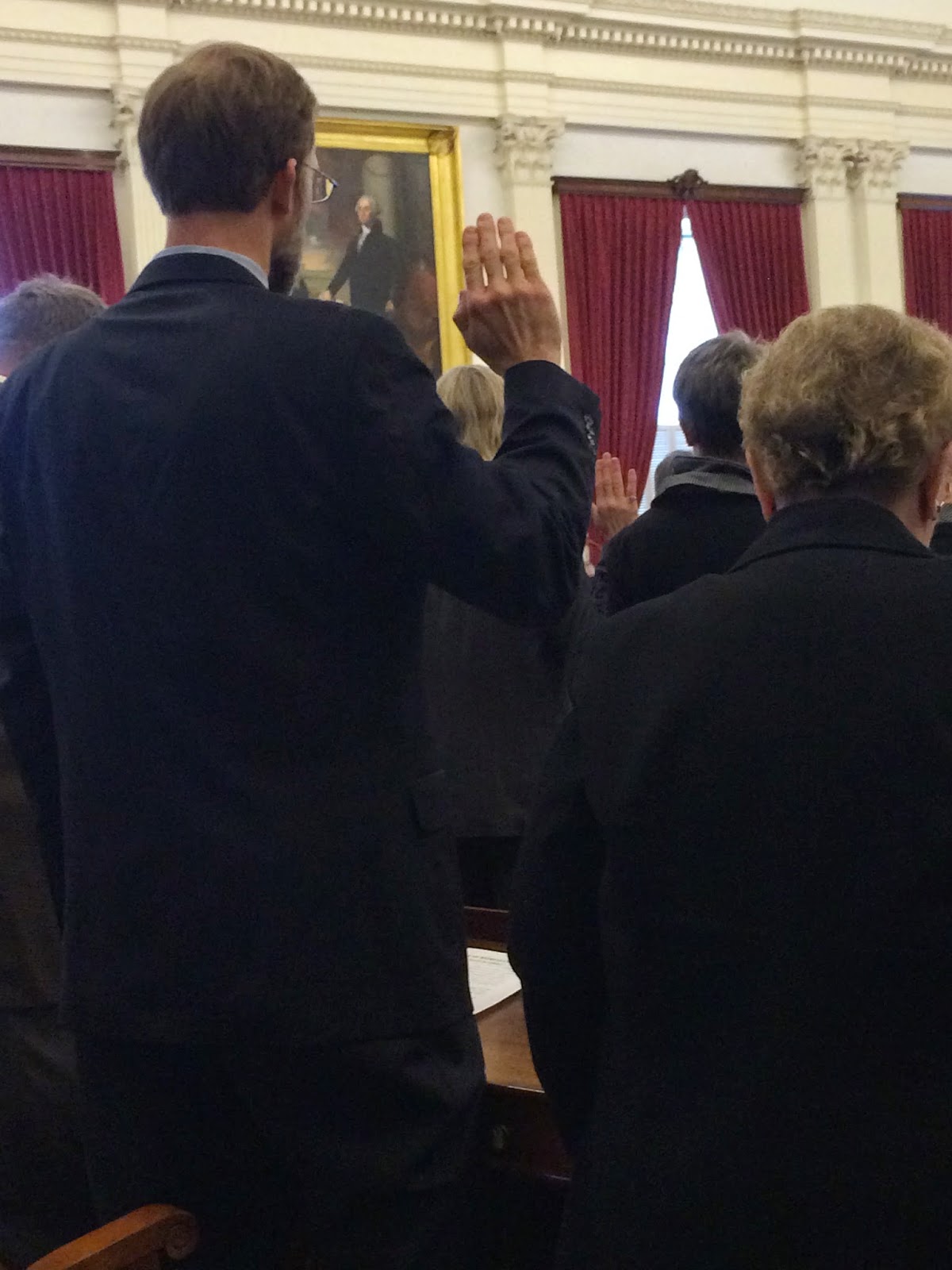
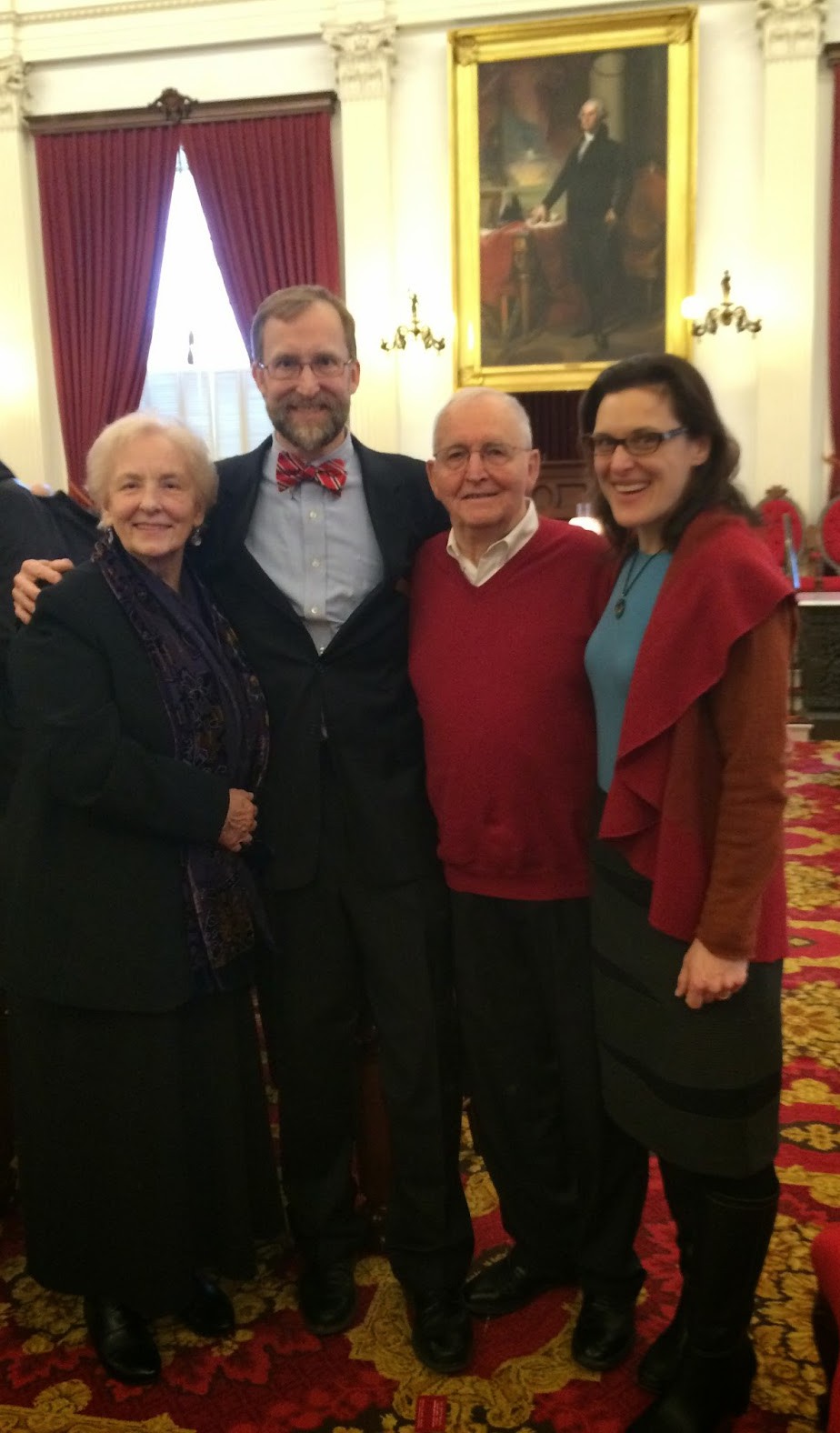
My parents came from Virginia to see me sworn in, and my wife Anne also came to Montpelier to support me.
My Legislative Introduction in the “Other Paper”


RETN Forum for Uncontested House Candidates
I recently participated in a televised forum on RETN for the House candidates in South Burlington. View the program here.
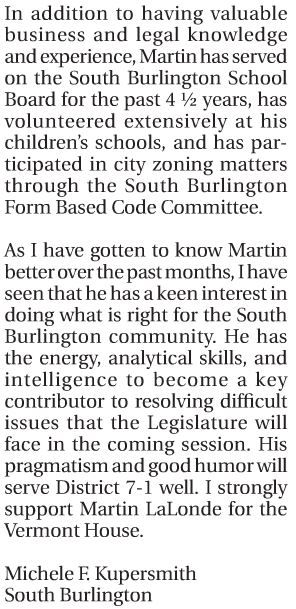
Letter of Support from Michele Kupersmith
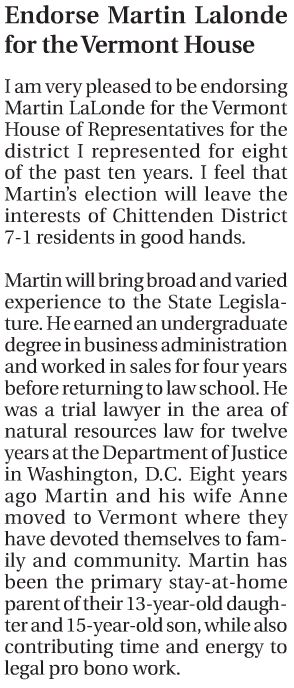
Michele Kupersmith, my predecessor in the Chittenden 7-1 legislative seat, wrote a letter of support for me in the “Other Paper”:
 Vermont State House Representative Martin LaLonde
You must be logged in to post a comment.