Appropriations and Revenue Bills

I have found the Vermont Statehouse to be largely nonpartisan. This is most evident within committees, which for the most part put politics aside and try to derive the most workable solutions to the problems they face. The Judiciary Committee, on which I serve, has so far this session passed twelve bills out of committee, each on 11-0 votes.

This past week, the Appropriations Committee on an 11-0 bipartisan basis voted out of committee the budget bill for fiscal year 2016 (H.490). The nonpartisanship abruptly ended. However, once the whole House took up this bill along with a revenue/tax bill (H.489), which had passed out of the Committee on Ways and Means on a party-line 8-3 vote.

Before the third reading of these bills, a group of Republicans offered amendments plainly aimed solely at scoring political points, not at trying to resolve the underlying issues facing the legislature. They sought to cast themselves on the side of lower- and middle-income Vermonters by suggesting a reduction in taxes on those making less than $60,000 and an increase in spending on low income heating assistance. They did not, however, provide offsetting additional taxes on those earning higher incomes or realistic spending cuts.

In any event, the budget and revenue bills did eventually pass with some bipartisan support and without the Republicans’ amendments. And despite the political game playing that occurred, I do recognize the benefits of having a minority party that acts as a check on the majority. Further, through trying to reach compromise among the parties – the Democrats, Republicans, and Progressives – the legislature as a whole can achieve a better solution. In order to reach compromise, though, each party is likely going to have to accept some outcomes or positions that they find disagreeable.

Indeed, this was certainly the case with both the revenue and budget bills. I initially found aspects of the bills to be objectionable, but those aspects were the price of passing bills that, overall, are steps in the right direction for fiscal sustainability in Vermont. Also, as I delved more deeply into the explanation of those aspects of the bill, what I found alleviated my concerns enough so that I was comfortable voting for the bills.

As to the revenue bill, I disliked its apparent potential disincentive to charitable giving. Among other changes to the tax code to raise revenue, the bill caps itemized deductions, including for gifts to charitable organizations, at two and a half times the standard deduction amounts (a couple filing jointly, for example, could still deduct $31,500). Because these deductions provide an incentive for giving, a number of nonprofit organizations objected that scaling them back would hinder their fundraising.

As I learned, though, the actual impact on charitable giving would likely be very limited. Most of the tax benefit from a charitable contribution comes from the federal deduction, which is two to three times more valuable than the state benefit. It would make little financial sense to stop contributing to charities because of the limitation of the state deduction while foregoing the more valuable federal deduction.

People donate for a variety of reasons, not simply to receive a tax deduction. In fact, only 30% of Vermonters itemize their deductions but many more than that contribute to charities. The cap on deductions will affect a small group of taxpayers, resulting in a tax increase for slightly more than 6% of filers.

In effect, the cap on deductions, as well as other aspects of the revenue bill, results in a more progressive income tax. Given that the income growth for the top two income brackets in Vermont has grown significantly over the past several years, while middle class income has for the most part stagnated in the state, adding progressivity to the tax system made good sense to me.

I had a number of issues with the cuts proposed in the budget bill, but my major concern related to a $6 million cut in funding to the Low Income Heating Energy Assistance Program (“LIHEAP”). During the floor debate, however, I learned that the effect of this cut should not be dramatic. LIHEAP is a federal program. Up until recently, Vermont supplemented the program by providing state dollars through the Emergency Board, which would consider the need for additional funding in the fall after federal dollars for the fund had been designated. Two years ago, the legislature instead appropriated money for LIHEAP up front rather than waiting until it understood the extent of the federal investment in the program. The budget bill will return the state to the previous procedure.

Further, as the economy has improved and as fuel costs have decreased, the pressure on LIHEAP’s resources have decreased. As of the end of February, LIHEAP still had $3 million available if it needed a crisis grant, which is an additional benefit provided to households experiencing a heating crisis. This amount, if unused, will roll over to next year’s program. Finally, an amendment was approved that will designate up to $5 million of any general fund surplus at the end of this fiscal year to LIHEAP. In short, low income Vermonters are not at risk of losing the LIHEAP assistance that they may need next winter.

Having largely addressed my major concern with the budget bill, I was able to focus on its more positive features. First, in conjunction with the revenue bill, it closes the $113 million budget gap that the state was facing in the next fiscal year. Second, the FY 2016 budget is not an end point but part of a long term process of fiscal change to achieve a balance between the state’s spending and its expected revenue growth rates. Spending was projected to grow by five percent annually, while the state’s domestic product is projected to grow by only three percent annually.

As the Appropriations Committee has explained, to meet this balancing goal, the budget bill:

1) Reduces reliance on one-time funding. In the last fiscal year, the budget relied on $53 million in one-time funds. This budget includes $25 million in one-time funds and next year’s budget is projected to include just half that.
2) Reduces the rate of spending growth. To this end, the budget includes a number of efforts to reduce long-term spending in corrections, public safety, buildings, and other areas.
3) Sets forth two additional longer-term goals: to move toward budgeting for less than 100% of projected revenues and to explore a two-year budget, allowing time in the second year to focus on results-based accountability, evidence-based budgeting, and structural reforms.

Slower than anticipated economic growth, continued federal reductions in programs, and a growing demand for state services have created a difficult budget environment. The FY 2016 budget that was passed on to the Senate starts a multiyear process that will bend the spending curve toward long term sustainability. For more on these bills, I would suggest reading April Burbank’s recent article in the Burlington Free Press.
Judiciary Committee Update

In the past week, the House passed a variety of bills that had been voted out of the Judiciary Committee. One such bill would ensure that States Attorneys file cases involving juveniles in the Family Division of state court, where certain confidentiality and other procedural protections are in place, rather than in adult criminal court, which lacks such protections (H.95). Another bill would make it a crime to disseminate sexually explicit photographs or videos of individuals online without their consent, even if the subject had consented to the taking of the photograph or video (H.105 as amended). A third bill would make it easier to prosecute home improvement fraud (H.483).

The Judiciary Committee took testimony on a bill passed out of the Senate that would modify procedures related to placement on the Sex Offender Registry (S.13). Currently, the Department of Public Safety administers the Registry, making decisions as to the posting of an offender’s information to the Registry before his release from incarceration. The bill would instead have the court make determinations related to an offender’s inclusion on the Registry at the time of sentencing, deciding whether the offender should be placed on the Registry and, if so, for how long. In addition, the bill provides a procedure to allow individuals to challenge the information on, or to request removal from, the Registry. These changes were prompted by audits of Registry’s error-rate, which were performed to determine whether address information would be included on the Internet version of the Registry. The Committee is considering what Registry error rates would be acceptable to allow an individual’s address information to be placed on the Internet Registry, which would be widely available to the public.

In addition, the Committee has taken up a bill relating to criminal justice reform (H.221). This bill would, among other changes, reduce the number of crimes punishable as felonies; eliminate jail time for non-violent offenders; prevent people from being kept in jail at the end of their sentence due to lack of housing; expand parole eligibility for individuals who have serious medical conditions, were sentenced for an offense committed as a juvenile, or are 65 years of age or older; and eliminate incarceration for violations of parole conditions that are not new crimes. The overall aim of the bill is to reduce unnecessary incarceration and thus reduce Vermont’s prison population and its associated costs. It represents a start in updating the 19th and 20th century solutions in Vermont’s criminal code that are currently used to address our 21st century problems.

Judiciary also took testimony on the enforcement provisions of the water bill (H.35). It has made recommendations to the Committee on Fish, Wildlife, and Water Resources suggesting changes to those provisions of the bill. In addition, Judiciary started its consideration of the Child Protection Bill, (S.9), participating in a joint hearing with the Human Services Committee.

Judiciary took testimony from and worked with the State Court Administrator and Chief Superior Judge to evaluate efficiencies that could lead to savings in the Justice System. For example, the state courts are considering an initiative to start conducting arraignments by video conferencing, which would produce savings from decreased need to transport defendants and for Court security. The Committee provided its various proposals related to Court savings to the Committees on Ways and Means and Appropriations.

False Claims and Young Dems

It has been a busy week in the legislature after returning from the Town Meeting Week recess. The House passed a bill, H.40, that sets a renewable energy standard for Vermont, with emphasis on utilities meeting goals for renewable energy and efficiency. The Judiciary heard extensive testimony on enforcement provisions included in the water cleanup bill, H.35. In addition, Judiciary passed out of committee three bills: H.95, which makes incremental progress toward having cases against juvenile offenders brought more often in the family rather than the criminal division of Superior Court; H.105, which makes it a misdemeanor to disclose sexually explicit images without consent (so called revenge porn); and a committee bill that strengthens the ability of the Attorney General to bring cases against contractors for home improvement fraud.

Today, the House passed a bill, H.120, that I helped report out on the House floor yesterday.

Reporting Out H.120

The bill proposes to create a Vermont False Claims Act — an anti-fraud law modeled on the Federal False Claims Act (“FFCA”). The FFCA was first enacted in 1863 to combat fraud by suppliers of goods to the Union Army during the Civil War. Since that time, the FFCA has been amended several times to broaden its scope and enhance its ability to combat fraud against government funds in all sectors. Starting in 2009, the federal government has used the FFCA to recover over $23 billion in cases related to government programs.

The Vermont False Claims Act would provide for penalties for anyone who knowingly submits false or fraudulent claims to the State’s government. It would also authorize a person who has evidence of fraud, called the relator, to bring action on behalf of the State against those who commit fraud against government programs. Any recovery is refunded to the State, and in certain circumstances such as those involving Medicaid, to the federal government. Relators are eligible to collect a percentage of the funds recovered as an award for having rooted out such fraud.

The federal government has had such success in combating fraud and abuse with the FFCA that it created incentives in the Deficit Reduction Act (“DRA”) of 2005 for states to enact anti-fraud legislation of their own. These incentives relate specifically to recovery in cases of Medicaid fraud. The Medicaid program is funded jointly by the federal government and each state’s governments. Normally any recovery of funds fraudulently obtained under the Medicaid program are returned to the federal and state governments proportionally to the shares that each pay into the program. States that enact DRA-compliant legislation are qualified to receive a ten percent increase in their share of any amounts recovered under these laws. As a result, the majority of states have enacted some form of a False Claims Act.

If H.120 is ultimately enacted, Vermont’s share of Medicaid fraud recovery will increase from 46% to 56%. The financial incentive would allow Vermont to compensate Relators, while ideally detecting, enforcing, and recovering a greater percentage of the fraudulent claims filed in the state.
Enactment of the bill would have a positive impact on revenue for the State. The Joint Fiscal Office estimated that, through the law, Vermont could recover at least $280,000 dollars annually.

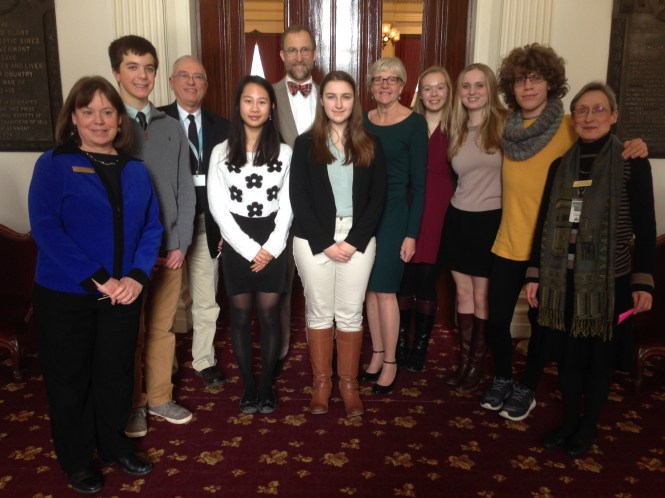
Earlier this week, we were visited by members of the South Burlington High School Young Democrats. I introduced the group from the floor of the House and the four South Burlington representatives chatted with them about our work. Here we are with the Young Dems.

Young Dems Visit the Statehouse

Town Meeting Day 2015

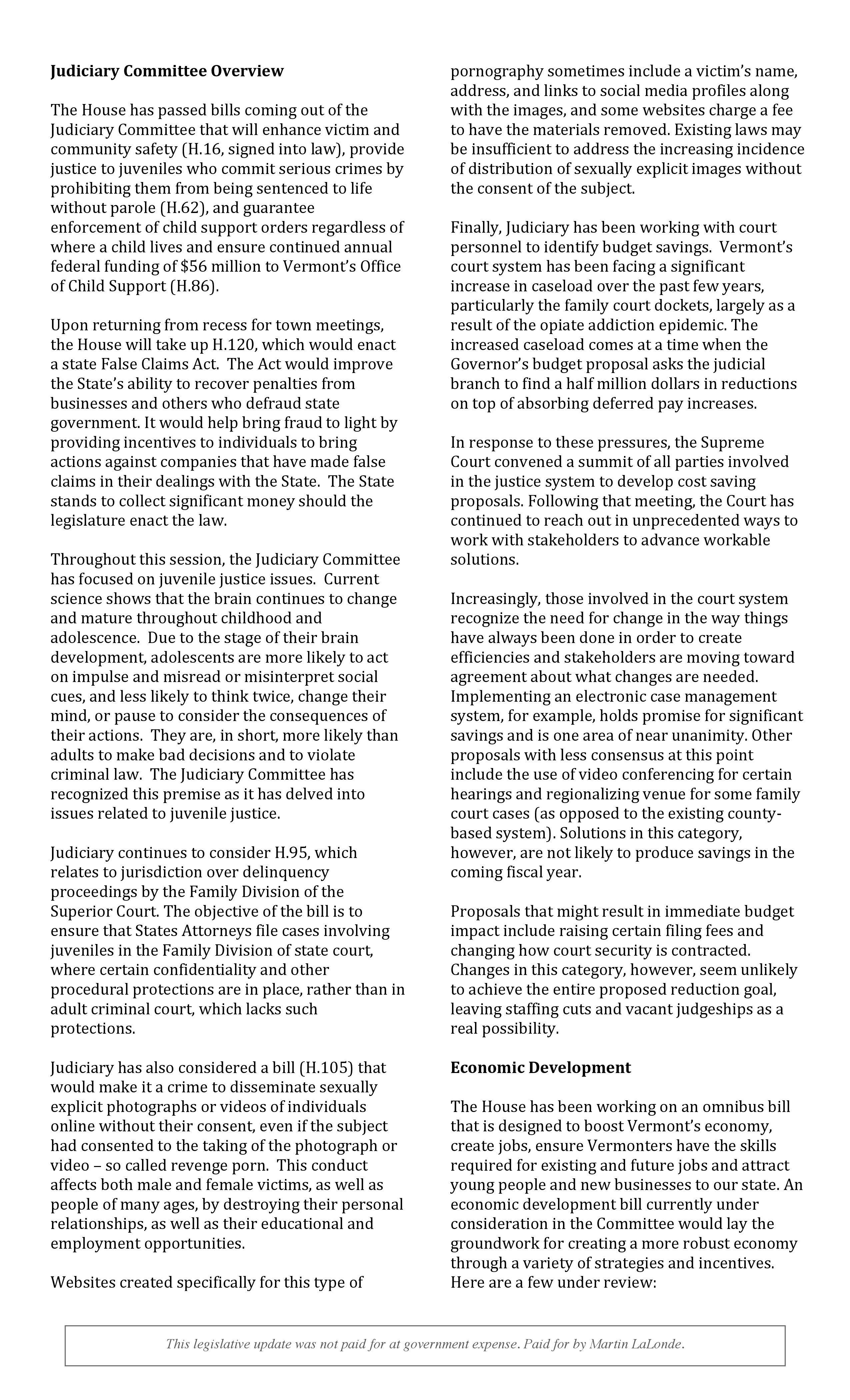
Today is Town Meeting Day in South Burlington, and tomorrow is Election Day.  I prepared a summary of my Committee’s activities so far, as well as other relevant legislative updates, as a handout for my constituents on Election Day.

page-0

page-1

page-2

page-3

False Claims Act and Other Judiciary Committee Work

In the Judiciary Committee, we continued to review H.120, which proposes a state False Claims Act. The basic purpose of the Act is to protect public funds, and the state stands to collect significant money should it enact the law.

The Act would improve the state’s ability to recover penalties from businesses and others who defraud state government. It would help detect fraud by providing incentives to individuals, known as relators, to bring actions against companies that have made false claims in their dealings with the state.

H.120 is modeled after the federal False Claims Act, which has resulted in the recovery of billions of dollars from defendants. The federal law is frequently used to address Medicaid fraud, including in Vermont. Because Medicaid is a joint federal and state program, approximately 46% of any recovery in such actions is shared with Vermont. To give states an incentive to enact their own False Claims Act, and thus increase enforcement, the U.S. Congress has provided that any state adopting such an act would receive an additional 10% of any funds recovered. Judiciary has heard from various interests and, with certain adjustments to the bill, most testimony has favored enactment.

Judiciary also heard testimony on H.95, relating to jurisdiction over delinquency proceedings by the Family Division of the Superior Court, and H.105, relating to the online dissemination of sexually explicit photographs or videos of individuals without their consent. In the coming week, the committee will consider redrafts of these bills.

In addition to false claims, delinquency, and “revenge porn,” the committee took up H.103, which would add psychological abuse as a ground for obtaining a Restraint From Abuse order. Although recognizing the concerns related to such injuries, testimony on behalf of the Judicial Branch and other witnesses emphasized the great difficulty in basing emergency restraining orders on allegations of psychological abuse.

Also, this week I joined the basketball caucus, a Friday early morning get-together at Montpelier’s Recreation Building of eight to twelve legislators and other Statehouse stalwarts. We have real jostling for advantage and elbows flying on the court for an hour in advance of the verbal jostling that might occur on the House floor later in the day.

Lake Champlain Cleanup

This past Wednesday both the House and the Senate met in a “joint caucus of the whole” to listen to speakers address one of the most pressing issues before the legislature this session: cleanup of Vermont’s water. As the President of the Lake Champlain Regional Chamber of Commerce emphasized, what is at stake is the Vermont Brand. In competing to attract and grow businesses, Vermont’s advantage is not in providing tax incentives, a deep work force, or an inexpensive cost of living. Rather, the State is blessed with natural resources including clean air and water, recreational opportunities, and a socially responsible population that is connected to the environment. A polluted Lake Champlain with algae blooms and unswimmable waters tarnishes the Vermont Brand, providing less incentive for businesses to move here or visitors to spend their leisure dollars here.

Other speakers explained that if we do not do something about the phosphorous pollutants streaming into the lake, the Environmental Protection Agency will step in with its blunt cleanup tools. Unlike the state, the EPA does not have authority to address pollution from nonpoint sources such as farms or impervious surfaces that contribute stormwater runoff. Rather, it can only tighten restrictions on wastewater treatment plants, which would have high costs for merely a slight decrease in pollution

State agencies, the legislature, and nongovernmental organizations have been studying the problem for years. And as they have studied, the State’s waters have become more polluted. It has taken years to get to the point of water degradation that we now face, and we learned that it will take years for the waters to become clean again. Governor Shumlin reiterated this point that other speakers made – Now is the time to take vigorous action.

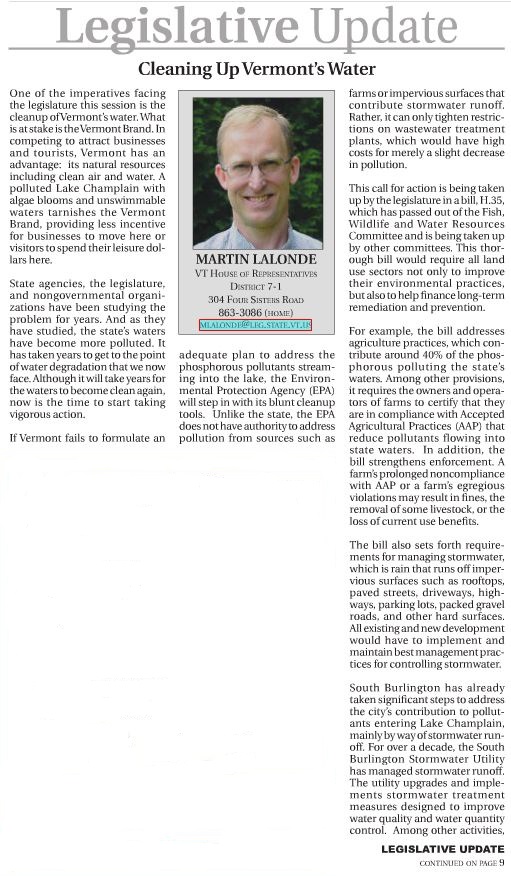
That call for action is finding its voice in H.35, which this week was passed out of the Fish, Wildlife and Water Resources Committee and will now be taken up by the Agriculture and Forest Products Committee. (House Fish & Wildlife Sends Out Tough Water Quality Bill, VTDigger).  The bill includes multiple provisions related to the remediation and preservation of the waters of Vermont. It requires all land use sectors to improve practices and to participate in providing resources to fund and finance a long term sustained remediation effort.

For example, the bill addresses agriculture practices, which contribute around 40% of the phosphorous polluting the state’s waters. It requires the owners/operators of small farms to certify that they are in compliance with Accepted Agricultural Practices (“AAP”), which are standards that farms must follow to reduce pollutants flowing into state waters. Such standards apply to storage of manure and fertilizers, animal holding areas, building locations relative to surface waters, vegetative buffers along adjacent surface waters, exclusion of livestock from surface waters, and more. Owners/operators of regulated farms will have to participate in water quality training as a condition of their permit or certification. Those who spread manure on farmlands will also need to be trained and certified. Finally, the enforcement provisions with regard to agriculture and water quality will be strengthened. Prolonged noncompliance with AAPs or egregious violations may result in permit or certification revocation, fines, the removal of some livestock, or the loss of current use benefits.

The bill also sets forth requirements for the management of stormwater, which is rain that runs off impervious surfaces such as rooftops, paved streets, driveways, highways, parking lots, packed gravel roads, and other hard surfaces. The bill would require all existing and new development to implement and maintain best management practices for controlling stormwater. As was recently reported in the Vermont League of Cities and Towns Weekly Legislative Report, among the roles envisioned by state policymakers and touched upon in H.35, “local governments will have to put in place practices to eliminate stormwater runoff from roads and impervious surfaces; protect rivers and streams from erosion; enact regulations to ensure that development occurs outside the floodplain, flood way, and river corridors; retrofit downtowns and urban centers to allow stormwater runoff to infiltrate the soil before it reaches the surface waters of the state; upgrade wastewater treatment facilities to remove more and more phosphorus from discharges; address combined sewer overflows; sweep streets; educate the public; and conform municipal plans to tactical basin plans.” Not all of these actions are necessarily included in H.35, but this provides a thorough list of what is and will be done to address the contribution of stormwater runoff and wastewater effluent to the water pollution problem.

South Burlington has already taken significant steps to address the city’s contribution to pollutants entering Lake Champlain, mainly by way of stormwater runoff. For over a decade, South Burlington has been in the business of stormwater management through its creation and continuation of the South Burlington Stormwater Utility. The Utility upgrades and implements stormwater treatment measures designed to improve water quality and water quantity control. Among other activities, it has upgraded the city’s stormwater infrastructure such as culverts, storm drains, and stormwater retention ponds, and has cleaned streets and storm drains. In the Laurel Hill neighborhood in District 7-1, the Utility installed four large underground storage tanks to detain water during large storms, which has reduced flooding. It is also working with the Stonehedge community to improve stormwater treatment and assisted in installing rain gardens in Queen City Park to reduce impacts from sediment and nutrient wash-off.

The Utility collects fees from property owners based on the extent of impervious surfaces on the properties. To date, South Burlington has spent over $13 million on stormwater management and over the next 20 years expects to spend upwards of $40 million more on capital improvement projects to comply with stormwater restrictions.

Tom DiPietro, South Burlington’s Deputy Director of Public Works, provided input to and testified before the Fish, Wildlife, and Water Resources Committee regarding these experiences as they relate to H.35.  He emphasized that the legislation is an important step in the cleanup of the state’s water, but that legislators should not take away funding from local communities to use at the state level because that would hamper local efforts to improve water quality. It remains to be seen whether final legislation will incorporate that advice, as the funding sources for the water improvement efforts remain unresolved. Such sources may include an impervious surface per parcel fee, a fertilizer tax (maybe just on non-agricultural goods), and/or rooms or meals tax increase.

I will follow the bill’s progress and will remain optimistic that legislation will be enacted this session to start the long process of cleaning the waters of Vermont, including the crown jewel of the state, Lake Champlain.

“Under the Golden Dome”

Yesterday I had the opportunity to share my views in “Under the Golden Dome,” a program produced weekly during the legislative session and named after the distinctive gold leaf on the dome of the Vermont capitol building.  In the program, legislators discuss current events in the State House.  I spoke about the effort to improve water quality in Lake Champlain as well as recent undertakings by the Judiciary Committee.  You can watch the video here.  My portion begins five minutes and twenty-seven seconds into the video.

Reporting out H.86, and other week six highlights

When a bill is first introduced in the House, it is called the first reading, even though the bill is note actually read aloud. At that time, the clerk of the House reads out just the title of the bill and the Speaker assigns it to a committee. Not all bills assigned to committees are acted upon during a session. If and when it does decide to take the bill up, the committee will hear from the sponsor of the bill and will take testimony from witnesses. The bill may still die in committee. Alternatively, the bill may be voted out of the committee, with or without amendments to the bill’s language as introduced. It will then go before the full House for the second reading, again not actually a reading. At the second reading, a legislator from the committee that has considered the bill will report it out, which entails explaining the bill on the floor of the House – its purpose, its provisions, why it should be passed, etc.

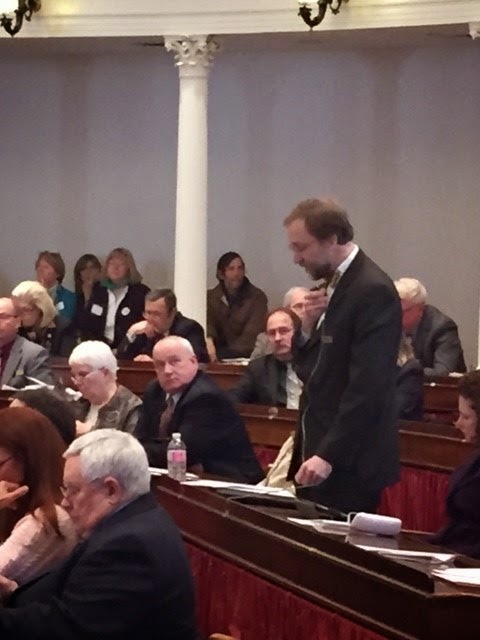
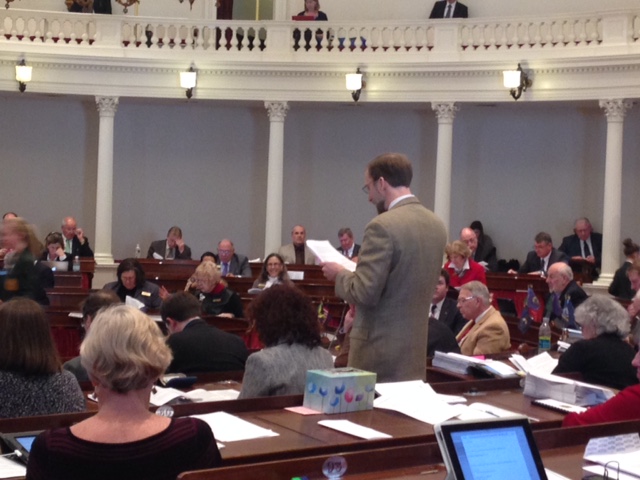
On Wednesday of this past week, I had my first opportunity to report out a bill, H.86, which is an amendment to the Uniform Interstate Family Support Act (“UIFSA”). Here is a photo of me reporting out the bill.

martin on the House floor 2 11 2015 rotated

As I explained to the rest of the representatives, H.86 amends UIFSA, originally enacted in Vermont in 1996. UIFSA establishes uniform rules for interstate enforcement of both child support and spousal support orders. The law has two overall goals: first, there should be one support order between parties that is controlling at any given point in time, and second, the terms of the support order should be readily enforceable in any state.

It is important to have uniform laws in this subject area because families move. UIFSA helps to ensure that children are being supported when a noncustodial parent owing support resides in a different state than the child. There are roughly 15 million child support cases nation wide and about half of these involve parents in different states or countries.

Increasingly, it is important to have more uniformity not just among states, but also among countries. To that end, in November 2007, the United States signed a treaty establishing uniform procedures for processing international child support cases. The Uniform Law Commission, a non-partisan organization that drafts uniform laws in areas of state law where uniformity is important, incorporated the requirements of the treaty into proposed amendments to UIFSA. In order for the treaty to go into effect in the United States, all 50 states must enact these amendments. They must do so or risk losing federal funds that support state child support programs. Failure to enact these amendments during the 2015 legislative session could result in Vermont’s annual loss of $56 million in federal funds. Enacting the UIFSA would not only ensure continued receipt of federal help for Vermont’s child support enforcement efforts, but would also improve the enforcement of Vermont child support orders abroad and ensure that children residing in Vermont will receive the financial support due from parents, wherever the parents reside.

After I explained this in my reporting out of the bill, other members had the opportunity to “interrogate” me by asking questions about the bill, or could make statements in support of or in opposition to the bill. In the case of H.86, no one interrogated me or made statements. It was a noncontroversial bill, plus a significant amount of federal funds rides on enacting the UIFSA amendments. After the opportunity to interrogate, the House voted unanimously to approve the bill for a third reading. After the vote, as I learned is traditional, a number of legislators had pages deliver notes to me congratulating me on my first opportunity to report out a bill – another example of the collegiality of the House.

Between the second and third reading, legislators have the opportunity to seek amendments to the bill. There were no amendments to H.86, and on Thursday, the third reading was held and, again, the bill was passed unanimously and has been moved to the Senate for its consideration.

Although preparing for reporting out H.86 took up quite a bit of my time last week, I was also involved with other matters. The Judiciary Committee took testimony on a number of bills, but spent most of its time considering a State False Claims Act, which provides incentives for individuals to report fraud or false claims of companies in their dealings with state government. It also took testimony on bills related to “revenge porn,” and whether cases involving minors should be filed in the family or criminal division of state court (see last week’s post for more information regarding these latter two bills).

In addition, I tried to keep up on other areas of interest. I attended the climate caucus, which is an informal gathering of legislators from all parties and from both the Senate and House who are interested in this particular topic. I also attended a gathering of legislators interested in rural economic development. Finally, I spoke with the chair of the House General, Housing and Military Affairs Committee, which is considering the bill that I introduced related to teacher collective bargaining. We discussed the status of the bill and a related bill and what additional testimony might be helpful. See my most recent article for The Other Paper, which I posted yesterday, for more information on this bill.

On a lighter note, the Friends of the Vermont State House, a citizen’s advisory committee, held a fundraiser during the week. They sold Valentine’s Day cards with Statehouse themes and provided the services of a calligrapher to write notes in the cards. I believe Anne, Griffin, and Tess each enjoyed receiving the beautifully inscribed cards today along with chocolate hearts that I purchased at a top-notch chocolatier in Montpelier. Happy Valentine’s Day.